Seasonal Tips
The Tiny Bacterium Behind Every Bushy Poinsettia

Vice President & Owner, Schlegel Greenhouse · November 20, 2026
Almost every bushy poinsettia sold for the holidays carries a tiny bacterium in its stems, and that bacterium is the reason it looks the way it does.
From Mexican shrub to holiday pot plant
A tall, leggy shrub in the hills of Mexico, up to about 10 feet
↓
A graft onto a bushier plant carries something across
↓
A phytoplasma, a tiny bacterium, moves into the stems
↓
The main tip stops bossing the side buds around
↓
A compact plant with many stems, each topped with color
In the wild, near Taxco in southern Mexico, the poinsettia is a shrub that can reach about 10 feet tall. Left alone, it sends up a few long, leggy stems. That makes a fine garden shrub in a frost-free climate and a poor plant for a 6-inch pot.
The reason is something growers call apical dominance. The growing tip at the top of each stem sends out signals that keep the buds below it asleep. Pinch the tip off and most plants answer with a flush of side shoots. The old poinsettias mostly didn't. They made a few shoots and went right back to growing tall.
A family secret in California
The Ecke family started selling poinsettias as cut stems in Los Angeles in the early 1900s, then moved their farm to Encinitas, near San Diego. Over the following decades they worked to turn a fragile cut flower into a lasting pot plant.
Their answer was a graft. When a stem of a tall, sparse variety was grafted onto a naturally bushier plant, the tall variety started branching too, and it kept branching in every cutting taken from it afterward. According to NPR, the family kept the method as a trade secret, and for years Ecke supplied most of the poinsettias sold in the United States. Paul Ecke Jr. eventually patented the grafting process in 1988.
Researchers were working on it, too. In 1988, John Dole and Harold Wilkins at the University of Minnesota reported that something passed through the graft and permanently changed how the plant branched. Once that work was published, other growers could make bushy poinsettias of their own.
What was moving through the graft
For years the main suspect was a virus. Poinsettias commonly carry poinsettia mosaic virus, and heat treatments that cleared the virus also seemed to take away the branching.
In 1997, a team led by Ing-Ming Lee at the U.S. Department of Agriculture's research center in Beltsville, Maryland, working with Ball FloraPlant, published the answer in Nature Biotechnology. The branching came from a phytoplasma. To prove it, the team used dodder, a parasitic vine, as a living bridge to move the phytoplasma into virus-free plants. The plants branched, and the virus had nothing to do with it.
A plant disease with a good side
Phytoplasmas are tiny bacteria with no cell wall. They live in a plant's sap-carrying tissue, and gardeners usually meet them as trouble. Aster yellows, which stunts coneflowers and turns their flowers into odd green tufts, is a phytoplasma. So are many cases of witches' broom, those dense clusters of thin shoots.
In a poinsettia, the same kind of organism does something useful. It quiets the growing tip so the side buds wake up, and it shortens the stretch of stem between leaves. The USDA called it the first known case of a disease-causing phytoplasma producing a desirable trait.
The trait can be lost. In one Norwegian study, heat-treating cuttings to clean out viruses left only 29 of 99 clean plants still branching. A plant grown from a lab-raised embryo doesn't branch either, because the phytoplasma isn't passed along that way. Cuttings carry it, which is why every new crop starts from cuttings off branched stock plants.
How the crop is grown today
Each poinsettia in a garden center starts as a rooted cutting taken from a stock plant in summer. About two to four weeks after potting, growers pinch the top, and the phytoplasma does its work: several side shoots grow out, each one headed for a cluster of colored bracts. Color comes in fall, once nights pass about 11 3/4 hours of uninterrupted dark.
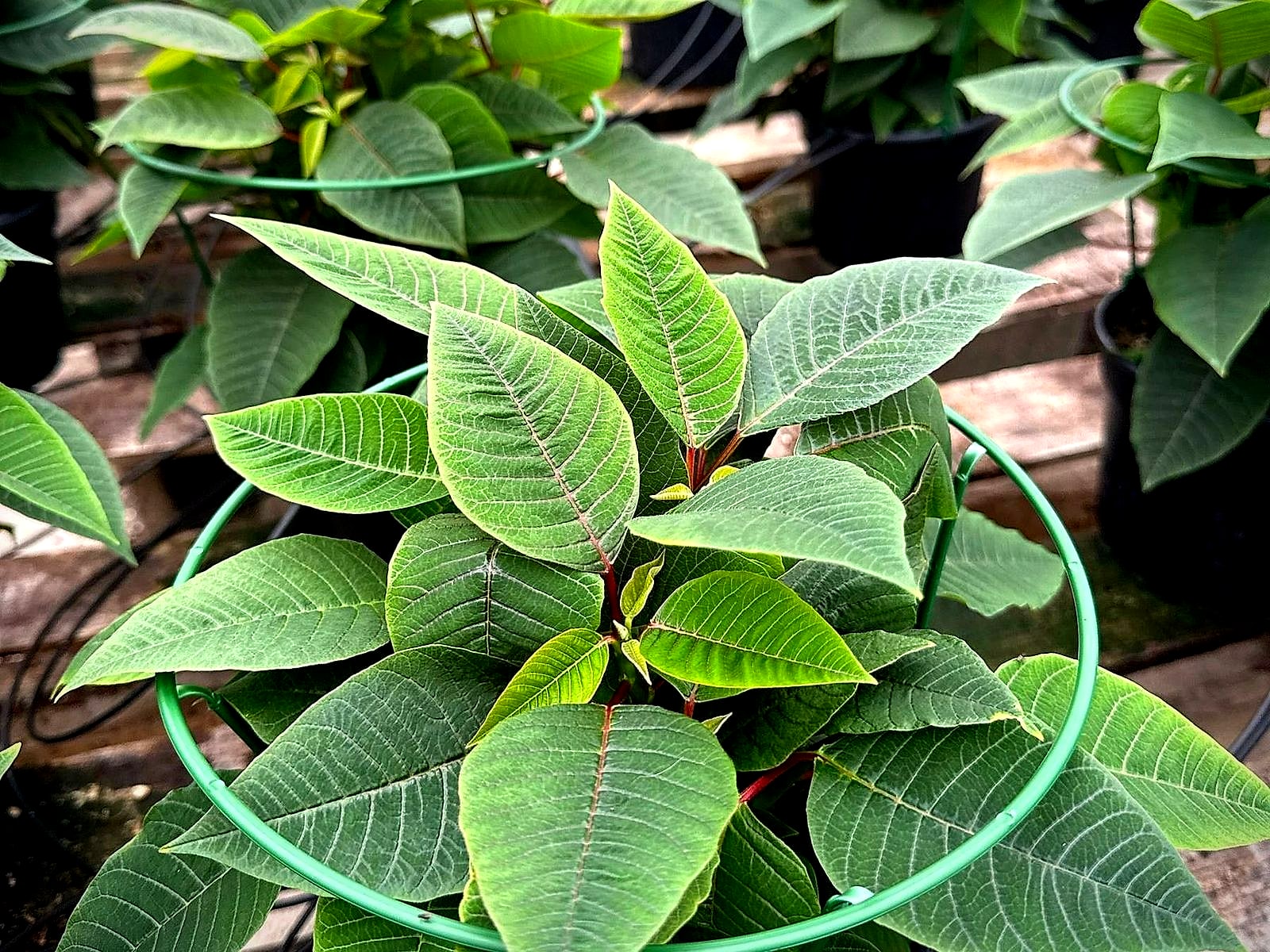
The photo above is from our greenhouse in late September, before any color showed. Look at the red stems inside the support ring. Each one will end in its own head of color by December.
That branching is a big part of why the poinsettia became America's holiday plant. In 2020, the latest year USDA figures break out, growers sold 35.4 million potted poinsettias. That puts it at or near the top of all potted flowering plants by number of pots, though orchids bring in more money.
What comes next
Breeders have since found poinsettias that branch through their own genetics, with no phytoplasma needed. A patent granted in 2015 covers branching poinsettias that are free of phytoplasma. For now, most of the poinsettias on store benches still owe their shape to the old passenger.
Is it safe in the house?
Yes. The phytoplasma lives only in the plant and isn't known to spread to other houseplants on its own. The poinsettia's old reputation as a poison doesn't hold up, either: a study of 22,793 poinsettia exposures reported to U.S. poison centers found no deaths, and over 92 percent had no symptoms at all. The milky sap can irritate skin, especially for people with a latex allergy, and the ASPCA lists the plant as mildly irritating to pets.
| Without the phytoplasma | With it | |
|---|---|---|
| Branching | A few shoots, even after pinching | Many side shoots after a pinch |
| Shape | Tall and open | Short and full |
| Stems | Longer gaps between leaves | Shorter gaps between leaves |
| Color | A few heads of bracts | A head of color on every branch |
| Best use | A shrub in a frost-free garden | A pot on the table in December |
More on seasonal tips, every Friday
Three growing guides like this one and a short note from the greenhouse, free, once a week. Written for Indiana gardens.
Reference: Lee et al., "Phytoplasma induced free-branching in commercial poinsettia cultivars," Nature Biotechnology 15 (1997); USDA Agricultural Research Service, "Poinsettia's Secret" (1998); U.S. Patent 4,724,276 (1988); Dole and Wilkins, Acta Horticulturae 226 (1988); University of Georgia Extension Bulletin 1580, Poinsettia Production; USDA NASS Floriculture Crops 2020 Summary; Krenzelok et al., American Journal of Emergency Medicine 14 (1996); NPR (2017).