 Seasonal Tips
Are Invasive Plants Making Our Allergies Worse?
Vice President & Owner, Schlegel Greenhouse · October 23, 2026
The relationship between pollen, invasive species, and longer growing seasons is more complicated than it might seem.
Every fall, as the weather starts cooling down, plenty of people in Indiana are waiting for the same thing: the first good frost.
Not because they’re particularly excited about winter, but because it often means the end of ragweed season.
Ragweed is one of the biggest causes of seasonal allergies in the Midwest. Its pollen travels through the air and can produce familiar symptoms such as sneezing, congestion, itchy eyes, and a runny nose.
But as invasive plants spread and growing seasons change, there’s an interesting question worth asking.
Are the plants around us making our allergies worse?
The answer is that some introduced and invasive plants can contribute to allergy problems, but the relationship isn’t as simple as saying more invasive plants always means more pollen.
First, ragweed isn’t invasive here
This surprises people.
Common ragweed, Ambrosia artemisiifolia, is native to North America.
So is giant ragweed, Ambrosia trifida.
Both are important contributors to seasonal allergies in Indiana, but neither is an introduced invasive species here.
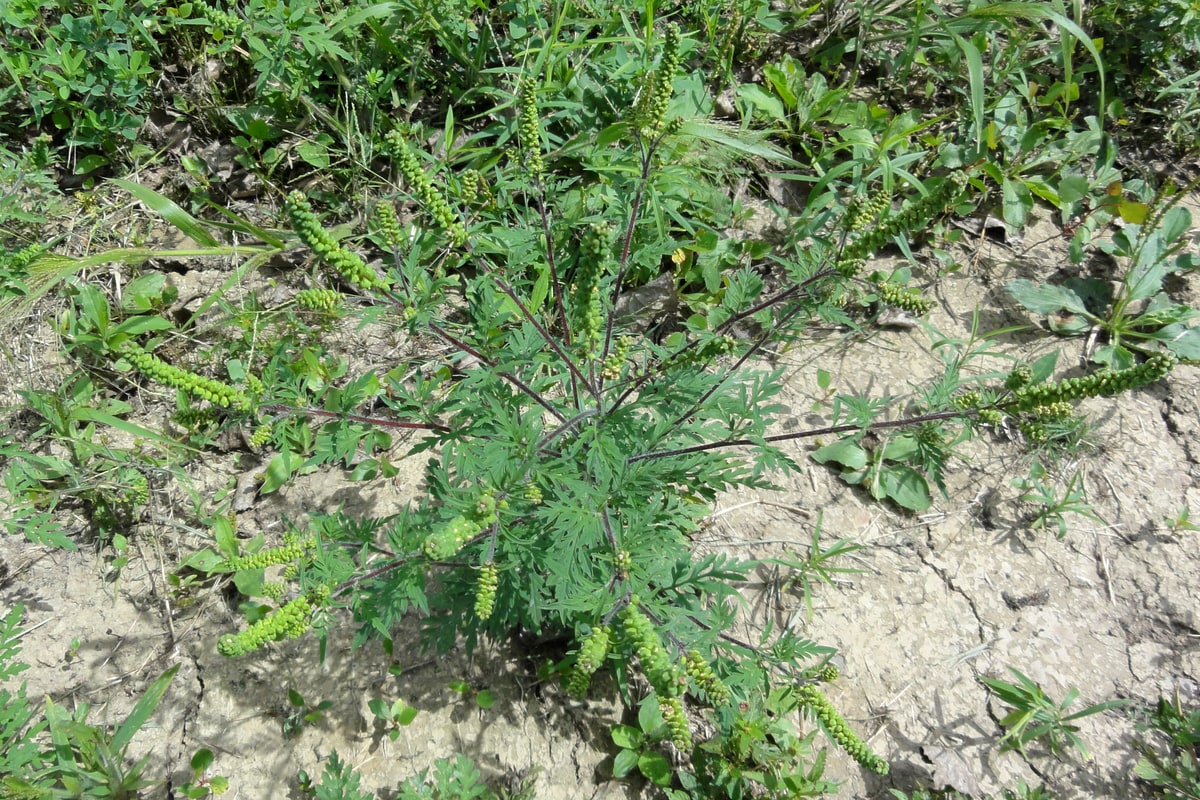
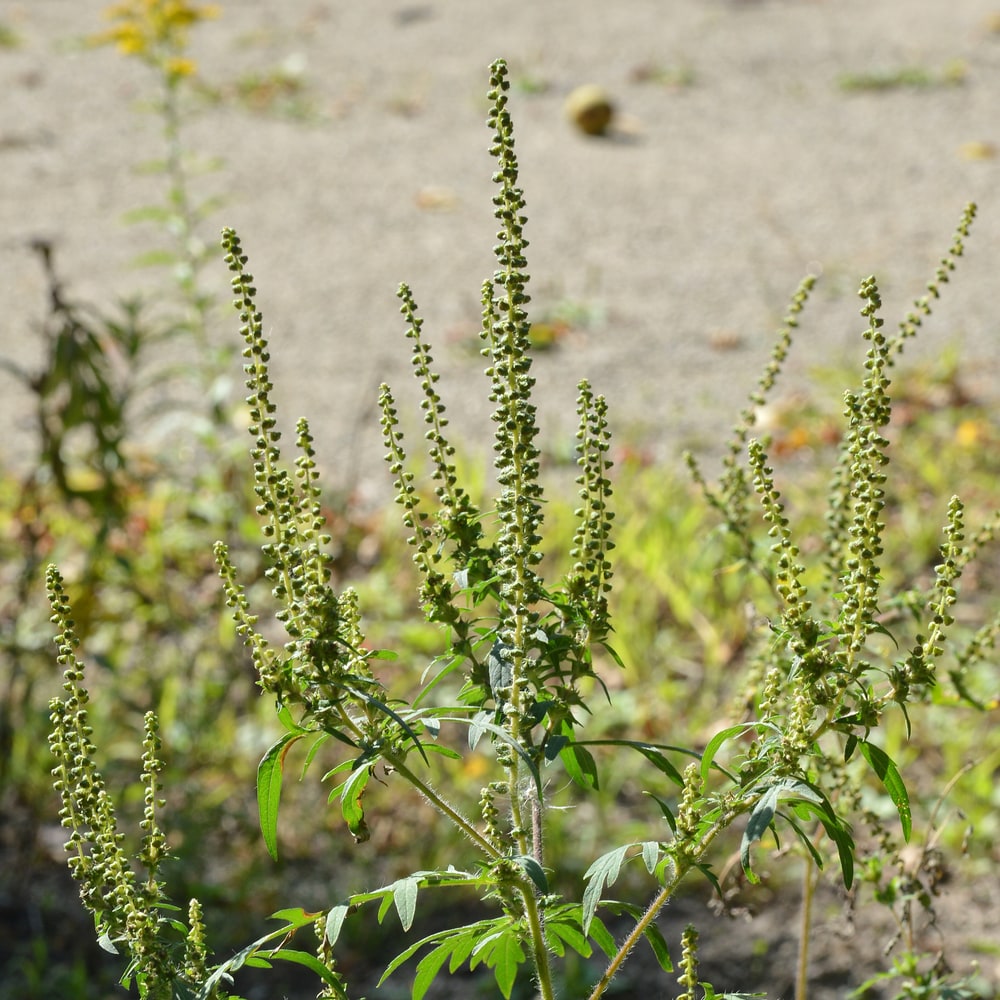
Common ragweed is easy to overlook: lacy leaves and green flower spikes, no showy petals. Photo: R. A. Nonenmacher, via Wikimedia Commons, CC BY-SA 4.0, cropped.
Ragweed is a particularly successful pollen producer because it relies on wind rather than insects for pollination.
Instead of producing large, attractive flowers designed to bring in bees or butterflies, it releases enormous quantities of small pollen grains into the air.
Those grains can travel substantial distances.
That means the ragweed causing your allergies may not even be growing on your property.
And it explains why pulling every weed out of your flower beds won’t necessarily make your neighborhood’s pollen problem disappear.
Some invasive plants do produce allergenic pollen
Mugwort, Artemisia vulgaris, is a useful example.
It’s native to Eurasia and is included on Indiana’s list of prohibited invasive terrestrial plants.
Mugwort spreads through disturbed areas such as roadsides and vacant lots. It also produces windborne pollen that can cause allergic reactions.
As mugwort establishes larger populations, it can increase exposure to another important pollen allergen in places where it becomes abundant.
Tree-of-heaven, Ailanthus altissima, is another introduced invasive species on Indiana’s prohibited list.
It was originally planted as an ornamental tree and has since spread into disturbed landscapes, particularly urban areas.
Its pollen has been identified as a potential allergy concern, although that doesn’t mean it’s responsible for the same share of Indiana allergy symptoms as ragweed, grasses, or common allergenic trees.
The important distinction is that not every invasive species is a major pollen source.
An invasive groundcover spreading through a woodland can cause substantial ecological damage without producing the kind of windborne pollen that drives regional allergy seasons.
Why the prettiest flowers often aren’t the problem
Here’s another misconception worth clearing up.
People frequently blame the most visible flowers in their yards when their allergies start acting up.
But showy flowers aren’t necessarily major contributors to airborne pollen.
Many garden flowers have relatively heavy or sticky pollen that gets transferred primarily by insects.
Wind-pollinated plants take a different approach. They produce large amounts of lightweight pollen and rely on air movement to carry it.
That’s why trees, grasses, and ragweed can be much more important sources of seasonal pollen exposure than many colorful garden flowers.
It also means we shouldn’t treat every nonnative ornamental flower as an allergy problem.
We need to look at the plant’s pollination biology, not simply where it originated.
Our allergy seasons are changing
The more significant story may be what’s happening to the growing season itself.
The U.S. Environmental Protection Agency has documented changes in ragweed pollen seasons in central North America.
In a historical analysis covering 1995 through 2015, ragweed pollen seasons became longer at ten of eleven monitored locations in the central United States and Canada.
The increases were generally more pronounced farther north.
There are several reasons this can happen.
Warmer conditions in spring can allow some plants to begin growing and producing pollen earlier.
Warm fall weather can extend the period during which plants such as ragweed continue releasing pollen.
Higher atmospheric carbon dioxide concentrations can also influence plant growth and pollen production.
The result is that some people may encounter allergenic pollen for more days during the year.
That doesn’t mean every season is worse than the last, or that every plant responds identically. Weather, rainfall, individual species, and local vegetation all influence pollen counts.
But longer growing seasons can create more opportunities for exposure.
Does urban development make a difference?
This is where our first article becomes relevant.
Cities change growing conditions.
They can be hotter than surrounding areas, contain extensive disturbed ground, and support different plant communities.
Those conditions can influence where certain weeds grow and how long they remain active.
The new University of Florida research suggests that some invasive plant populations may even develop greater tolerance to urban heat and drought.
That finding doesn’t prove those plants are producing more allergenic pollen.
But it raises a broader question: how might changes in plant populations affect the pollen people encounter in developed areas?
An invasive plant that produces allergenic pollen could potentially increase exposure if it becomes more widespread.
At the same time, a native plant such as ragweed can become more troublesome if environmental conditions allow it to produce pollen over a longer period.
We need to consider both.
What should gardeners do?
For anyone dealing with seasonal allergies, the most useful first step is understanding which pollen you’re reacting to.
Spring tree pollen, summer grass pollen, and late-summer or fall weed pollen follow different seasonal patterns.
Local pollen reports can help identify when particular types are most active.
If you have a plant producing allergenic pollen on your property, removing or managing it may reduce exposure nearby. But because pollen travels with the wind, controlling your own landscape won’t eliminate exposure from the surrounding area.
When you’re planning a garden, consider how plants reproduce as well as how they look.
And don’t assume that replacing an invasive plant with a native species will automatically reduce pollen exposure. Some native plants are major pollen producers, while many nonnative ornamentals contribute relatively little airborne pollen.
Reducing invasive species remains valuable because of their effects on natural ecosystems. Allergy reduction may be an additional benefit in certain situations, but it isn’t a universal outcome.
The bigger picture
The plants growing around us aren’t a fixed part of the landscape.
Cities expand. New species arrive. Growing seasons change. And plant populations respond to the conditions they’re exposed to.
All of those changes can influence the environment we live in.
As a grower, I find that connection particularly interesting.
We’re accustomed to thinking about plants in terms of flowers, foliage, growth habits, and how well they’ll perform in someone’s garden.
But plants affect us in less obvious ways, too.
Sometimes that includes the air we’re breathing.
Hoosier Tip
Ragweed pollen in Indiana usually starts in mid-August, but giant ragweed can bloom as early as July. Pull ragweed out by the roots in early July, and if you mow it instead, mow again a few weeks later, because it grows back and can still flower.
Top photo: common ragweed with its slender spikes of green, pollen-bearing flowers. Photo: Ryan Hodnett, via Wikimedia Commons, CC BY-SA 4.0, cropped.
More on seasonal tips, every Friday
Three growing guides like this one and a short note from the greenhouse, free, once a week. Written for Indiana gardens.
Reference: U.S. EPA, Climate Change Indicators: Ragweed Pollen Season (August 2016); U.S. EPA, Climate Change Indicators in the United States, Fifth Edition (2024); Indiana DNR, Terrestrial Invasive Plants; UConn Extension, Mugwort; Prenzel et al., Ailanthus altissima pollen sensitization, Journal of Asthma and Allergy (2022); Ziska and Caulfield, rising CO2 and ragweed pollen production (2000); Purdue Extension GWC-12, Giant Ragweed; WISH-TV, An update to ragweed season in Indiana (Sept. 6, 2024); Simard and Benoit, Effect of repetitive mowing on common ragweed pollen and seed production (2011); City of Goshen, Invasive Species Manual (2024); University of Florida IFAS (Sept. 21, 2026).