 Seasonal Tips
Should I Leave the Leaves?

Owner, Schlegel Greenhouse · September 25, 2026
Every fall gardeners hear the same advice: leave the leaves. It’s good advice, sometimes.
But I don’t think the answer should be to simply stop raking your yard.
There are good reasons to leave some fallen leaves in your landscape, and there are equally good reasons not to leave a six-inch wet mat of maple leaves covering everything until April.
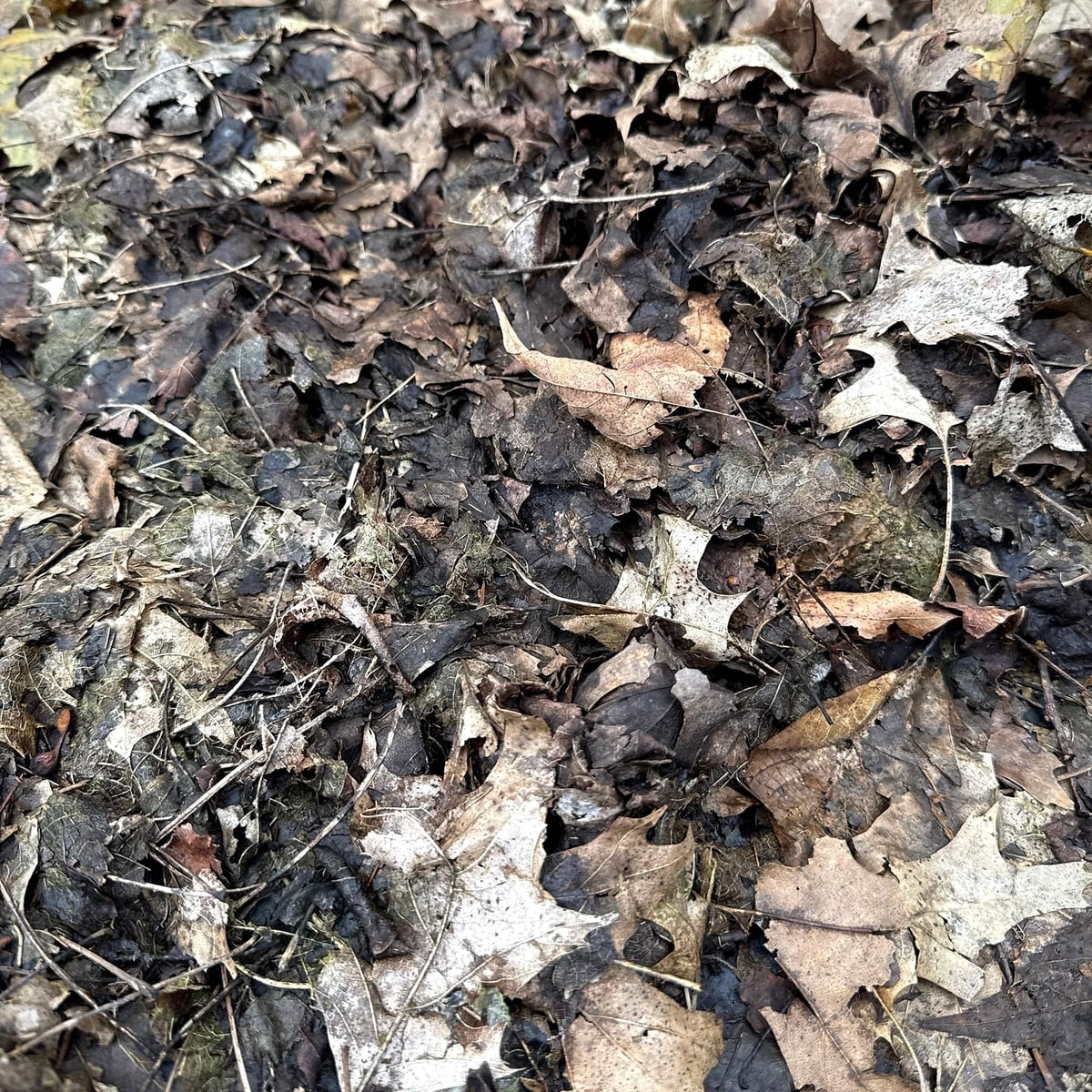
The layer in the photo above is the version you don’t want sitting on turf all winter — packed down, wet, and already matting together.
Here’s how I’d approach it.
Why Leave Any Leaves?
A layer of fallen leaves is completely normal in nature.
As leaves decompose, organic material returns to the soil. They also moderate soil temperatures and help protect the soil surface.
More importantly, that leaf litter is habitat.
Purdue recommends a balanced approach to fall cleanup because fallen leaves and dead plant material provide overwintering sites for beneficial insects, while standing flower stems and seed heads can support pollinators and birds.
So if your goal is to make your garden a little friendlier to wildlife, you don’t need to vacuum every square inch of it clean.
But Get Them Off the Lawn
This is where “leave the leaves” gets misunderstood.
You don’t want a heavy layer of whole leaves sitting on turf all winter.
A thick, wet mat can block light and air and smother the grass underneath.
Instead, you have a few options.
If the layer is light, mow over it. Chopping leaves into small pieces lets them settle between the grass blades and decompose much more quickly.
If there are simply too many leaves to mulch into the lawn, rake or blow them somewhere useful.
And one of the best destinations is your garden beds.
How I Would Leave Leaves in a Garden Bed
Don’t think six-inch pile. Think loose layer.
Move some leaves from your lawn underneath trees, around shrubs and into perennial beds. Whole leaves can work particularly well in more naturalized beds.
You can also run them through the mower first. Shredded leaves settle better, break down faster and are less likely to blow back into your neighbor’s yard.
Just don’t bury the crowns of your perennials under a heavy, soggy mat.
And there’s one important exception: don’t deliberately save diseased material. If your plants had serious fungal or bacterial disease, sanitation can matter. Purdue specifically qualifies its recommendation to leave material in garden beds as long as disease isn’t present.
The goal isn’t to make the garden messy for the sake of being messy. It’s to stop treating every dead leaf as garbage.
What About Oak Leaves?
People worry about this one a lot.
Oak leaves are tougher and decompose more slowly than many other leaves. That’s not necessarily bad in a perennial or woodland-style bed where you actually want a mulch layer to persist.
If you want them to disappear more quickly, shred them.
You don’t need to throw them away simply because they’re oak leaves.
What Should I Do With the Rest?
If you’ve got mature trees, eventually you reach the point where there’s simply more material than you can reasonably use.
Then municipal collection or composting makes sense.
Indianapolis. Here’s the part people seem to miss every year: Indianapolis leaf collection is only a short seasonal window. In 2025, Indy DPW’s special collection ran for just four weeks, November 10 through December 5. Residents could put out up to 40 bags per week on their normal trash day at no additional charge.
As of late September 2026, Indy DPW has not yet published this year’s dates. That’s important — don’t put last year’s dates on your calendar assuming they’re this year’s. We’ll share the 2026 dates when they’re announced.
Last year’s rules required leaves in plastic bags, outside by 7 a.m. on your regular trash day and at least three feet from the trash cart. Outside the special collection period, bagged leaves could go inside the regular trash cart or be taken to the Citizens Transfer Station on Saturdays.
And don’t burn them. Leaf burning is illegal in Marion County.
Noblesville. Noblesville has already published its 2026 schedule. Both bagged and loose-leaf collection run October 12 through December 11, 2026. Bagged leaves use the city’s free compostable bags and are collected on your normal trash day. Loose-leaf crews continuously work their way around the city, and Noblesville warns that one complete circuit can take as long as four weeks.
That’s a good example of why you need to check the rules where you actually live. There isn’t one Indianapolis-area leaf program. Carmel, Fishers, Greenwood, Zionsville and the surrounding communities operate their own systems and schedules, and several of them hadn’t posted a 2026 fall schedule yet when this was written.
The Best Solution Might Be No Pickup at All
Before you put 20 bags at the curb, look around your yard.
- ✓ Can some be mulched into the lawn?
- ✓ Can some go under your trees?
- ✓ Can some stay in the perennial beds?
- ✓ Can you compost some?
If so, you’ve taken something you were going to throw away and turned it into part of the garden.
You don’t have to leave all the leaves. But you probably don’t need to get rid of all of them either.
Hoosier Tip
When Indianapolis announces its 2026 pickup window, put it on the calendar the same day. If history is any indication you’ve got about four weeks to remember it, and the week it closes is exactly the week the last of the oak leaves finally come down.
Reference: Purdue Extension fall garden cleanup recommendations; Indianapolis DPW 2025 leaf collection program; City of Noblesville 2026 leaf collection schedule.