 Plant Selection
Don't Eat Me! Why Ornamental Kale and Cabbage Belong in Your Fall Garden

Vice President & Owner, Schlegel Greenhouse · September 11, 2026
By September, I think we make a mistake if we assume every fall planting needs to be a mum — ornamental kale and cabbage may actually give you a longer season of color, and they’re only just getting started.
I love mums. We grow a lot of them. But if you’re replacing tired annuals in a landscape bed or rebuilding a planter for fall, ornamental cabbage and kale deserve a serious look. And unlike most of the plants you’ve been growing all summer, cold is on their side.
They’re Basically Giant Flowers Made Out of Leaves
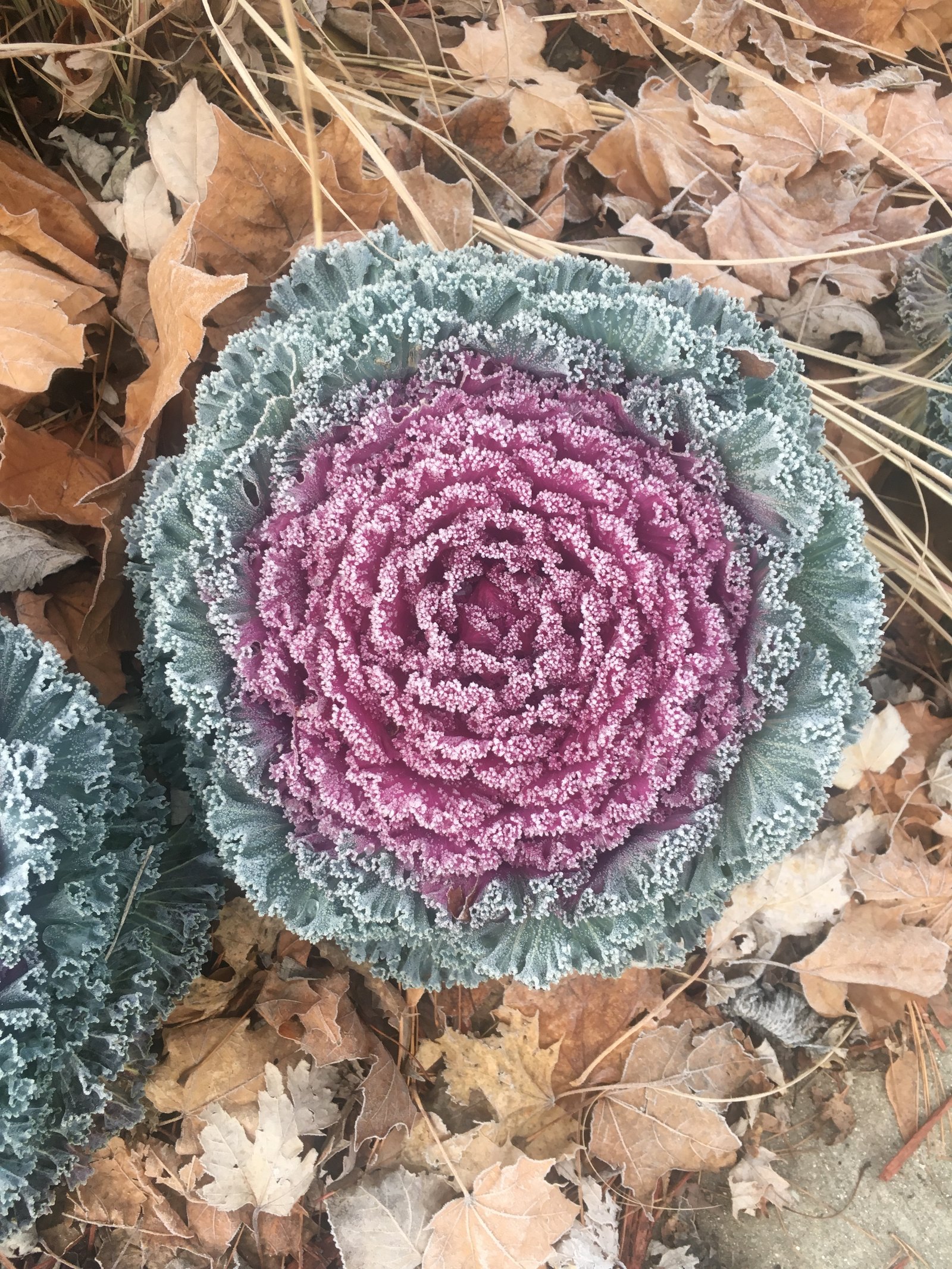
Ornamental kale and cabbage aren’t grown for their flowers. What looks like the “flower” is actually a rosette of leaves. The outer foliage tends to stay green, blue-green or purple while the center develops increasingly strong white, pink, red or purple coloration.
And here’s the part that makes them perfect for September: cold makes them prettier.
The pigments really begin developing as temperatures fall below about 50–55°F. Frost and cold weather intensify the colors further. That’s almost the exact opposite of your summer annuals.
Your petunias are looking at a 40-degree night wondering what happened. Your ornamental kale is thinking, finally.
They Last Longer Than You Probably Think
People sometimes treat ornamental kale like a mum — something that’s going to disappear with the first real frost. It isn’t.
These are Brassicas, relatives of the cabbage, broccoli and kale we eat, and they’re remarkably cold tolerant. A light frost is no problem. A hard frost doesn’t necessarily finish them either.
Illinois Extension says ornamental kale can remain colorful down around 20°F, with plants capable of surviving temperatures as low as approximately 5°F. North Carolina Extension reports similar cold tolerance once plants have acclimated.
What a Cold Night Does
| Plant | Light frost (30°F) | Hard freeze (20°F) |
|---|---|---|
| Petunia | Damaged | Done |
| Garden mum | Flowers usually fine | Flowers finished |
| Ornamental kale | Colors get stronger | Still colorful |
That’s why I like them so much for fall landscapes. You can plant them in September and potentially still have substantial color when practically everything you planted in May is long gone.
The Ones We Grow
We grow several different types because the foliage can look surprisingly different from one variety to another.
- ✓ Crystal — compact plants with glossy, non-waxy foliage and very strong center color.
- ✓ Nagoya — that heavily frilled edge and tight rosette. It’s probably closer to what most people picture when they hear “ornamental kale.”
- ✓ Glamour Red — shiny, wax-free foliage surrounding a bright magenta-red center. An All-America Selections winner.
- ✓ Coral Queen — looks completely different. Its leaves are deeply cut and feathered, giving the whole plant a finer texture than the big rounded leaves of many ornamental types.
And then we grow something that isn’t a kale at all.
Bright Lights Swiss Chard
Bright Lights is technically an edible Swiss chard, but it’s too pretty not to use ornamentally.
The leaves are dark green to bronze, while the stems can come in yellow, gold, orange, pink, red, white and combinations in between. It won All-America Selections back in 1998, and Wisconsin Extension specifically recommends it as an ornamental as well as an edible crop.
Put it behind a low ornamental kale and suddenly you’ve got height and color without needing a flower.
Okay … Can I Actually Eat Them?
Here’s where the “Don’t Eat Me” headline is a little dishonest. Technically? Yes.
Ornamental cabbage and kale are still Brassica oleracea. They aren’t poisonous. They’re just bred primarily for appearance rather than flavor and tenderness, and ornamental varieties can be considerably more bitter than the kale you’d intentionally grow for dinner.
Bright Lights is different. That’s genuinely an edible Swiss chard that also happens to be beautiful.
But if you bought an ornamental plant from a garden center, I’d leave it in the landscape unless you know how it was produced and what products were applied to it. A plant being botanically edible doesn’t automatically mean it was grown as a food crop.
So for our purposes: don’t eat me. Just look at me.
Don’t Redo the Whole Garden
This is probably my favorite way to use these plants. You don’t need to pull everything out on Labor Day weekend.
- ✓ If your geranium still looks great, leave it.
- ✓ If your Angelonia is still flowering, leave it.
- ✓ If the coleus has finally become enormous, definitely leave it.
But that petunia that’s turned into six long stems with three flowers? It’s okay. It had a good summer. Pull it out.
Put a Crystal kale there. Add a Coral Queen. Stick some Bright Lights behind it. Add a mum or aster if you want flowers.
Now you’ve transitioned the garden into fall without throwing away everything that still looks good. And over the next month, something interesting happens. As your summer plants finally begin slowing down, the kale gets better.
That’s exactly what I want from a fall plant.
Hoosier Tip
Buy ornamental kale at the size you want it to be. Unlike a mum, it won’t grow much once nights turn cool, so a small plant in September is still a small plant in November. Pick the fuller one, set it slightly deep, and let the cold do the coloring.
More on plant selection, every Friday
Three growing guides like this one and a short note from the greenhouse, free, once a week. Written for Indiana gardens.
Reference: University of Illinois Extension · NC State Extension · University of Wisconsin Extension · All-America Selections · Schlegel Greenhouse production notes