 Plant Selection
Daisy Mums vs. Decorative Mums: Why Don't We See More Daisies?

Vice President & Owner, Schlegel Greenhouse · September 3, 2026
Not every mum looks like the mum you’re probably picturing — and the reason you see so few daisy-flowered mums at the garden center has more to do with the calendar than with beauty.
Most garden mums you’ll see this fall have what growers call a decorative flower form: a dense flower filled with petals. But chrysanthemums can produce several different flower forms, including one that looks much more like a traditional daisy.
And when a daisy mum is fresh and completely covered with flowers, it can be one of the prettiest mums in the greenhouse.
So why don’t growers produce more of them?
There’s a tradeoff.
What Makes a Daisy Mum Different?
Look closely at a daisy mum and you’ll see an obvious center surrounded by a ring — or sometimes several rings — of petals.
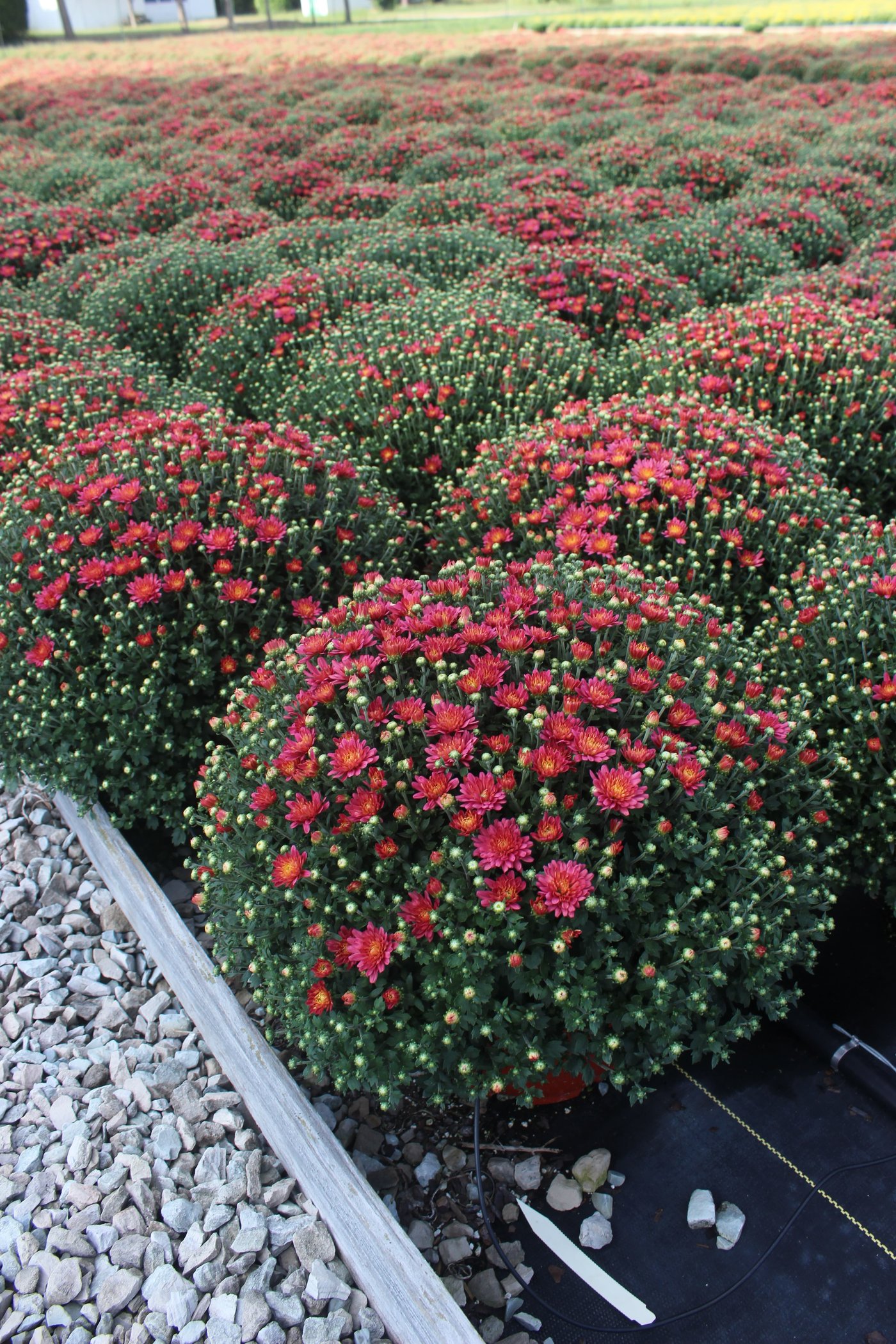
A decorative mum is much fuller. Its ray florets cover most or all of the center and create the dense, rounded flower we normally associate with a fall mum.
Two Different Mums
|
DAISY Open center |
DECORATIVE Full flower |
I Actually Really Like Daisy Mums
When they’re right, they’re beautiful. The visible center creates contrast that you don’t get from a decorative mum, particularly on varieties where the center and petals are dramatically different colors.
A plant covered in fresh daisy flowers can have a lighter, more natural look than a traditional mum.
If I were judging the two plants on the day they first reached peak color, there are daisy mums I’d choose over a decorative without hesitation.
The problem comes later.
Mums Have to Look Good for More Than One Day
We’re not growing a mum for a photograph. It has to flower here. Then we have to ship it. Then it may spend days or weeks at a garden center. Then somebody takes it home and expects it to continue looking good on their porch.
That’s where decorative mums generally have an advantage.
As a daisy flower ages, the change can be fairly obvious. The exposed center ages, petals fade or deteriorate, and individual spent flowers can stand out against the fresher ones around them.
A full decorative flower tends to age more gracefully visually. There are simply more petals creating the overall display, and the aging of an individual bloom isn’t always as immediately noticeable.
Ball specifically markets decorative varieties such as Red Ryder around their strong “keeping quality” in landscapes and containers — exactly the kind of characteristic growers and retailers value.
Why Growers Usually Prefer Decorative Mums
For us, consistency matters. We want a mum to look good when it leaves our greenhouse and still look good when you find it at a garden center.
A decorative mum generally gives us a longer window where the entire plant looks fresh. That’s important when you’re growing thousands of plants.
If a variety has an incredibly beautiful three-day peak but then rapidly looks tired, that’s much harder to work with than a variety that looks very good for two or three weeks.
The best plant isn’t always the one with the prettiest individual flower. Sometimes it’s the plant that looks good the longest.
And Breeders Know What Growers Want
Plant breeding responds to the market. If growers consistently prefer decorative flower forms because they ship well, have good retail life and age better in the landscape, breeders have a strong incentive to put their resources into improving those types.
That’s part of why you see so many decorative mums. Breeders aren’t just selecting for flower color. They’re looking at:
- ✓ Flowering time
- ✓ Plant habit
- ✓ Branching
- ✓ Heat tolerance
- ✓ Flower coverage
- ✓ Stem strength
- ✓ Keeping quality
- ✓ How uniformly the flowers open
Ball’s current mum descriptions are a good example. A European-habit decorative such as Dove White is specifically promoted for prolific, uniform flowering and a spherical plant habit, while Red Ryder is promoted for strong stems and keeping quality.
Those aren’t particularly exciting characteristics to put on a plant tag. They’re incredibly important when you’re trying to grow a good mum.
Does That Mean Daisy Mums Are Worse?
No. They’re different.
If you find a fresh daisy mum at a garden center and love it, buy it. At peak flower, I think some of them are as beautiful as anything we grow.
Just understand that you may notice the individual flowers aging sooner, and a little deadheading can make a bigger difference in keeping the plant looking clean.
Decorative mums are generally the safer choice when the goal is a long-lasting, uniform display. Daisy mums make their case differently. For a shorter period of time, they can put on one heck of a show.
Hoosier Tip
Shopping for a mum you want to last? Pick a decorative that’s showing color but is mostly still in bud — you’ll get the full display at home instead of on the store shelf. Shopping for a daisy mum? Buy it just as it opens, enjoy the peak, and snip out spent flowers every few days to keep the plant looking fresh.
More on plant selection, every Friday
Three growing guides like this one and a short note from the greenhouse, free, once a week. Written for Indiana gardens.
Reference: Ball Seed garden mum variety descriptions (Red Ryder, Dove White) · Schlegel Greenhouse production notes