 Indiana Growing
Are Our Cities Making Invasive Plants Tougher?
Vice President & Owner, Schlegel Greenhouse · October 23, 2026
New research suggests that urban environments may help some invasive plants adapt to heat and drought.
We usually think of invasive plants as species that spread into places where they don’t belong, crowding out the plants that were already there.
But researchers at the University of Florida have been investigating another possibility. What if the places where invasive plants first become established are actually helping prepare them for more difficult growing conditions?
It’s an interesting question because cities are particularly challenging environments for plants. They can also be among the first places where introduced species become established.
A plant growing out of the pavement
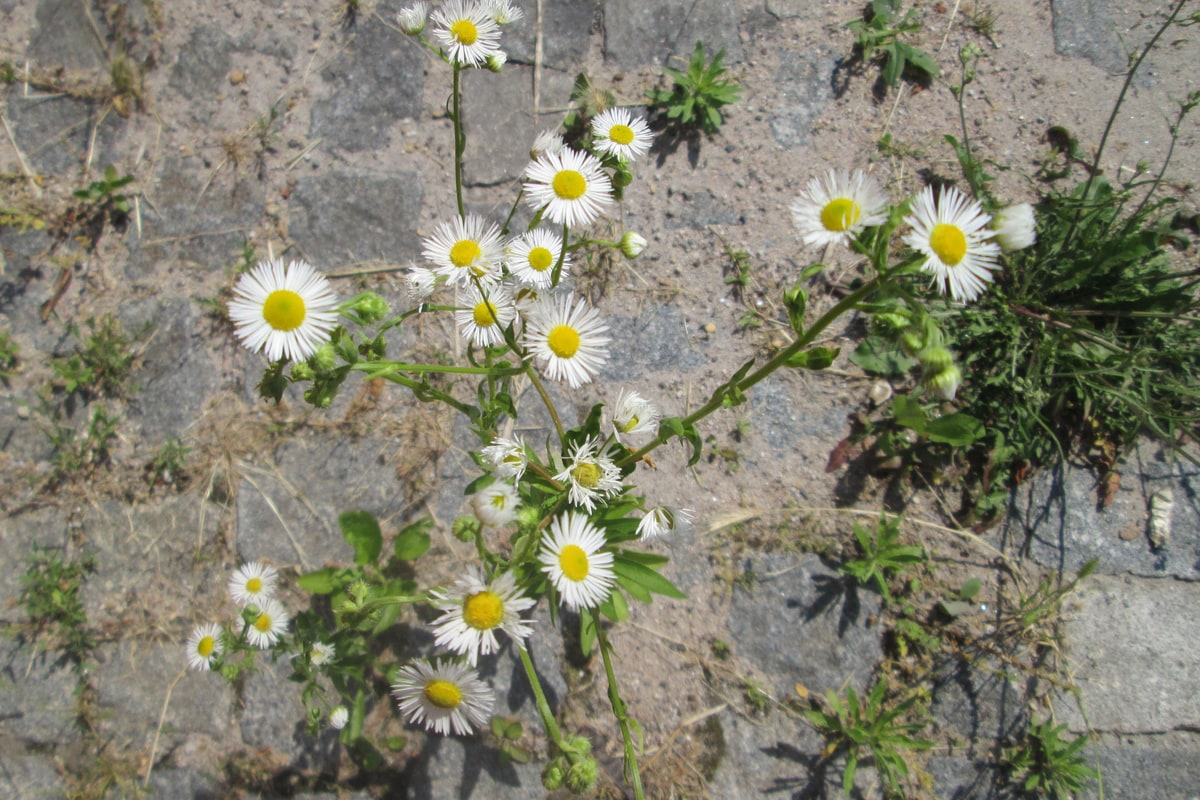
The researchers studied daisy fleabane, Erigeron annuus, a plant native to North America, including Indiana, that has become invasive in parts of Europe and Asia.
They collected seeds from populations growing in urban and rural locations around Zagreb, Croatia, and brought them to the University of Florida for testing.
The plants were grown under controlled conditions, with some exposed to higher temperatures, others to reduced water availability, and others to both.
They found something interesting.
Plants originating from urban areas tended to grow smaller than those from rural populations, but they were also less affected by heat and drought.
That tolerance became more pronounced among plants collected from more heavily urbanized locations.
In other words, the urban plants appeared better equipped to tolerate some of the stresses that researchers expect to become increasingly common.
That doesn’t necessarily mean they were more aggressive growers. In fact, they were generally smaller. Their advantage was that they were better able to tolerate unfavorable conditions.
The findings were published in September 2026 in the journal Plants, People, Planet.
Why would cities make a difference?
If you’ve ever walked across a parking lot on a hot summer afternoon and then stepped into a shaded yard, you’ve experienced part of the answer.
Pavement, roofs, and buildings absorb and retain heat. Developed areas often experience higher temperatures than surrounding countryside, a phenomenon known as the urban heat-island effect.
Urban plants also deal with compacted soils, limited rooting space, disturbed ground, inconsistent moisture, and runoff from paved surfaces.
These conditions can favor plants that are particularly good at surviving stress.
Over generations, populations exposed to those conditions may develop different characteristics from populations of the same species growing elsewhere.
That’s what makes the University of Florida study interesting. It suggests that urbanization may do more than provide a place for invasive species to establish themselves. Under some circumstances, it may also favor plants with traits that help them tolerate changing environmental conditions.
The researchers haven’t demonstrated that every invasive species responds this way, or that the urban plants in their experiment will necessarily spread faster into new habitats. But the possibility deserves attention.
What does this mean for Indianapolis?
Think about how central Indiana has changed.
New subdivisions, warehouses, commercial developments, roads, and parking lots have replaced fields and other open spaces in many growing communities.
Every new development creates disturbed ground, roadside edges, drainage areas, and landscaped spaces.
Those are places where introduced plants can become established.
They’re also places where plants may experience conditions quite different from those in surrounding natural areas.
Some invasive plants already do particularly well along roadsides, in abandoned lots, and at the edges of developed properties.
The new research raises a question worth considering: could those populations eventually become better equipped to tolerate heat and drought than populations growing in less developed environments?
We don’t yet have evidence that this has happened to particular invasive plants around Indianapolis. The Florida study involved one species growing in Croatia, and it’s important not to stretch the results beyond what was measured.
Still, it changes how I think about the relationship between cities and plants.
The same traits that make good landscape plants
There’s an obvious connection to horticulture.
When we’re evaluating plants for landscapes, we often look for characteristics such as heat tolerance, drought tolerance, adaptability, and reliable growth in difficult locations.
Those are desirable qualities.
A plant that thrives along a hot sidewalk or in a parking-lot planting can be valuable.
But if that same plant also produces large quantities of viable seed, spreads beyond cultivation, and displaces native vegetation, those strengths can contribute to an invasive problem.
It’s one reason we need to evaluate plants on more than their performance in a container or landscape trial.
How they reproduce, how far they spread, and what happens after they leave the maintained landscape are equally important questions.
A problem that may change over time
One of the things I found most interesting about this research is that it challenges the idea that a plant’s invasive potential is fixed.
We often talk about species as though their characteristics are permanent. But plants are populations of living organisms, and those populations can change over generations.
If urban conditions favor certain traits, plants growing in cities may become different from plants of the same species growing in the countryside.
That possibility matters as our cities expand and growing conditions change.
For gardeners, I think the lesson is fairly straightforward. A plant’s ability to survive difficult conditions is worth appreciating, but it shouldn’t be the only thing we consider before putting it in the ground.
Sometimes the plants that are easiest to grow are also the ones we need to watch most carefully.
Hoosier Tip
When a plant is sold as tough, fast-spreading or able to grow anywhere, look up how it reproduces before you plant it near a woods, creek or field edge. Tough is a virtue in a parking-lot bed. Tough and self-seeding next to a natural area is how problems start.
Top photo: daisy fleabane growing between paving stones in Saarbrücken, Germany, where it is not native. Photo: AnRo0002, via Wikimedia Commons, CC0.
More on Indiana growing, every Friday
Three growing guides like this one and a short note from the greenhouse, free, once a week. Written for Indiana gardens.
Reference: University of Florida IFAS, Cities worldwide may be the ultimate training grounds for invasive species (Sept. 21, 2026); Flory, Hiatt, Borden, Levačić and Jelaska, An urban evolved invasive plant tolerates experimental climate change, Plants, People, Planet (2026); Greenhouse Management, Cities may be the ultimate training grounds for invasive species (Oct. 2026); USDA PLANTS Database, Erigeron annuus.