 Plant Spotlights
These Don't Look Like Normal Pansies

Owner, Schlegel Greenhouse · September 11, 2026
Somebody in Japan took a regular pansy and added about three times as many ruffles — and next year we’re going to grow them.
I don’t think most people get particularly excited about a pansy. They’re great plants. They’re inexpensive, they’re tough in cool weather, and they’re one of the easiest ways to get color in early spring. But we’ve been growing pansies for a long time, and most of the varieties Americans see are variations on a pretty familiar flower.
Next year, we’re going to grow some that are very different. They’re Japanese pansies bred by Isao Sato.
It Started With One Strange Pansy
Sato Nursery’s story is actually one of my favorite parts of these plants.
Isao Sato started his nursery in Japan in 1988. At some point in his greenhouse, he noticed a pansy with unusually wavy petals. Instead of treating it as an oddball, he started selecting plants that expressed that characteristic more strongly.
He kept doing it for years.
Sato says it took about a decade of selection to create the type of heavily ruffled pansy he was looking for. Along the way, he discovered that cool temperatures intensified the curling of the petals and helped create the rounded flower form that became characteristic of his breeding.
That’s worth remembering when you see these. They didn’t come from somebody simply finding a new pansy color. The shape of the flower itself was being selected and refined.
From One Odd Pansy to Indiana
1980s — Isao Sato interns at a greenhouse in Colorado
↓
1988 — Opens Sato Nursery in Japan
↓
Spots one pansy with wavy petals and keeps selecting for it
↓
About a decade later — the heavily ruffled, rounded flower form is stable
↓
2018 — Robe de Antoinette collection sold commercially in Japan
↓
Tagawa Greenhouses (Colorado) partners with Sato: the Elegance Series
↓
Next year — a limited crop at Schlegel Greenhouse
Meet the Antoinette Collection
One of Sato’s best-known creations is Robe de Antoinette, or the Antoinette Collection.
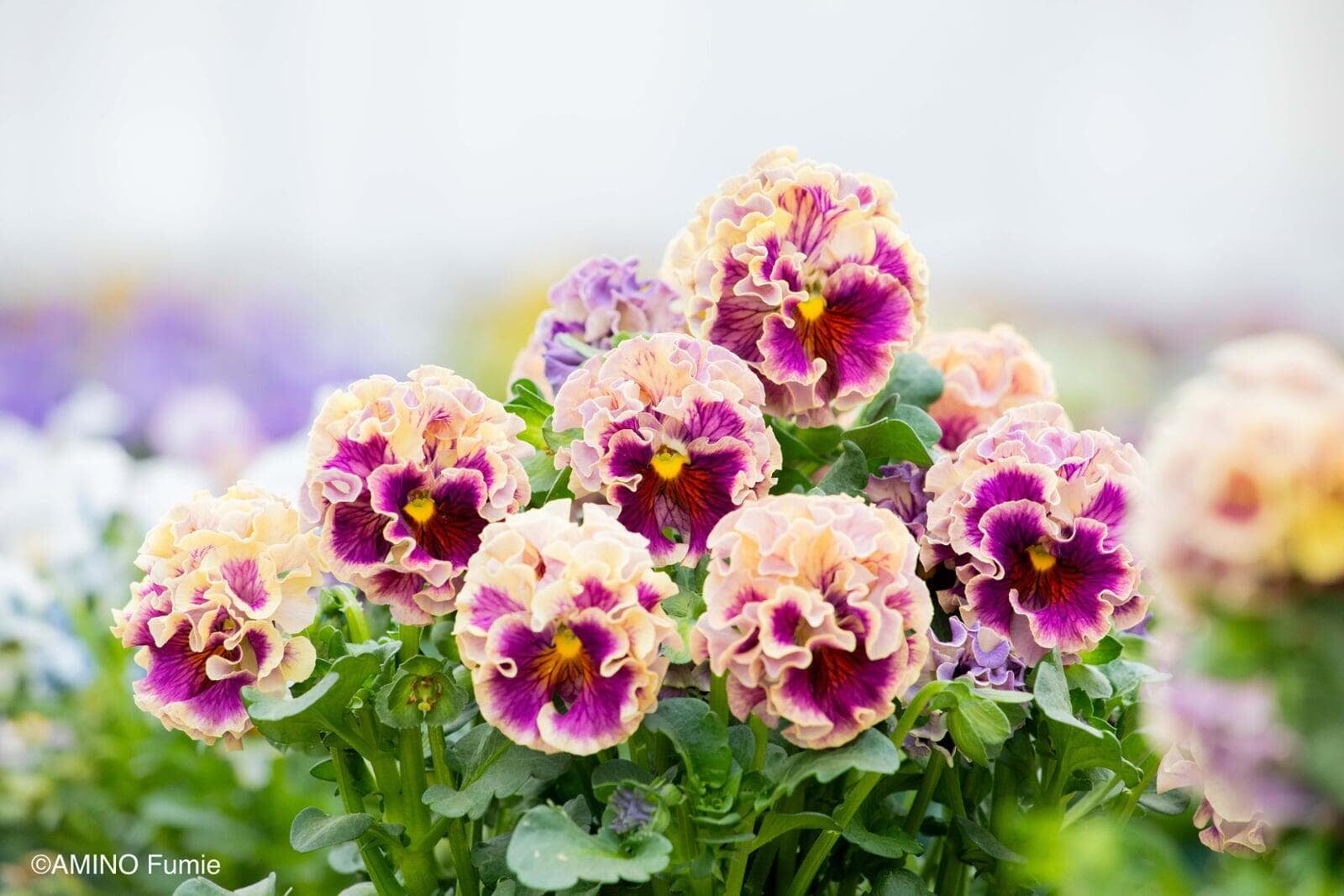
The name is a reference to Marie Antoinette’s elaborate dresses, which makes sense when you see the flowers. Instead of the relatively flat face of a conventional pansy, the petals are heavily ruffled and can curl inward enough to make the entire flower look almost round.
The colors are different too. Rather than concentrating only on the bright yellows, blues and purples we’re accustomed to seeing in pansies, Antoinette leans into softer pastel combinations. Sato Nursery describes the collection as having gentle pastel coloring, and it has been sold commercially in Japan since 2018.
No two flowers necessarily look exactly alike. That’s part of the appeal.
How Did a Japanese Pansy Get to Indiana?
There’s another interesting connection here. Sato actually spent time in Colorado as an intern during the 1980s. Today, Colorado-based Tagawa Greenhouses has a partnership with him that is bringing these genetics to the American market. Tagawa groups the plants into its Elegance Series, including the pastel Antoinette Collection and the darker Twilight Collection.
That’s what has finally made it practical for growers like us to get our hands on them. And we’re going to.
We’re Growing Them Next Year
We’ll have a limited crop of Sato pansies for next year.
They’re going to be considerably more expensive to produce than a conventional pansy, so we’re not treating these like another plant for a six-pack or flat. These are individual plants you buy because you want that particular plant.
I think they’ll be especially interesting in a nice container where you can actually see the flowers up close. They could also be mixed with conventional pansies and other cool-season plants, but I wouldn’t bury them in a big planting where the flower form gets lost.
And there’s another reason I’m excited to see them here. Cold weather makes the ruffling stronger.
That’s something Sato discovered during the breeding process and still notes about his varieties today: cooler conditions deepen colors and increase the curling and ruffling of the petals. In other words, the weird spring weather we get in Indiana might actually show these plants at their best.
We’ll have much more to show you once we’re actually growing them. For now, put Japanese pansies on the list of things to look for from Hoosier Boy next year.
Hoosier Tip
When you do find one, give it a pot of its own near a door or a path where you’ll pass it every day. A ruffled pansy is a plant you look at, not a plant you look across — and a cold snap that makes you want to stay inside is exactly when it will look its best.
Reference: Sato Nursery (Japan) breeding notes · Tagawa Greenhouses, Elegance Series · Schlegel Greenhouse production notes