 Plant Spotlights
The Poinsettias That Don't Look Like Poinsettias

Vice President & Owner, Schlegel Greenhouse · October 23, 2026
Mouse ears, rose-shaped leaves, unusual colors, and the problem of getting them ready for Christmas.
When most people think about poinsettias, they picture essentially the same plant: dark green foliage with a collection of bright red, pointed leaves arranged in a star at the top.
It’s such a familiar shape that we hardly think about it anymore.
But poinsettia breeders have been doing some pretty strange things with this plant.
There are now poinsettias with rounded leaves that look like mouse ears. Others have tightly curled leaves that resemble roses. Some have ruffled edges, some are covered in speckles, and others have irregular patches of color that look almost as though someone painted them.
A few barely resemble the poinsettias we grew twenty or thirty years ago.
And that’s what makes them interesting.
The poinsettia shape gallery
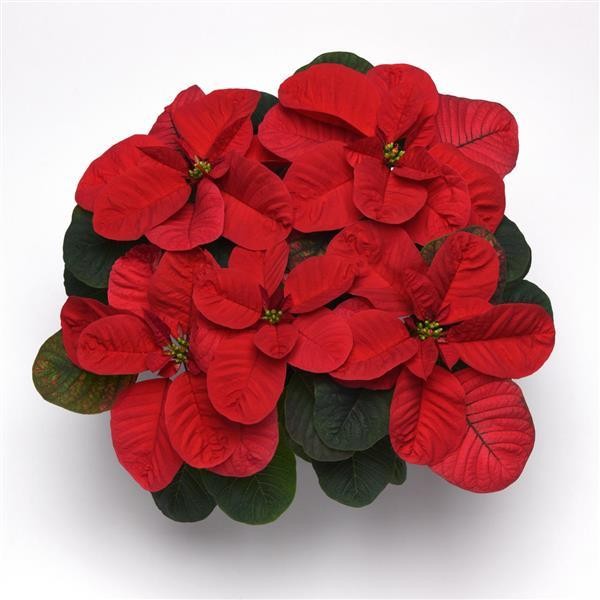
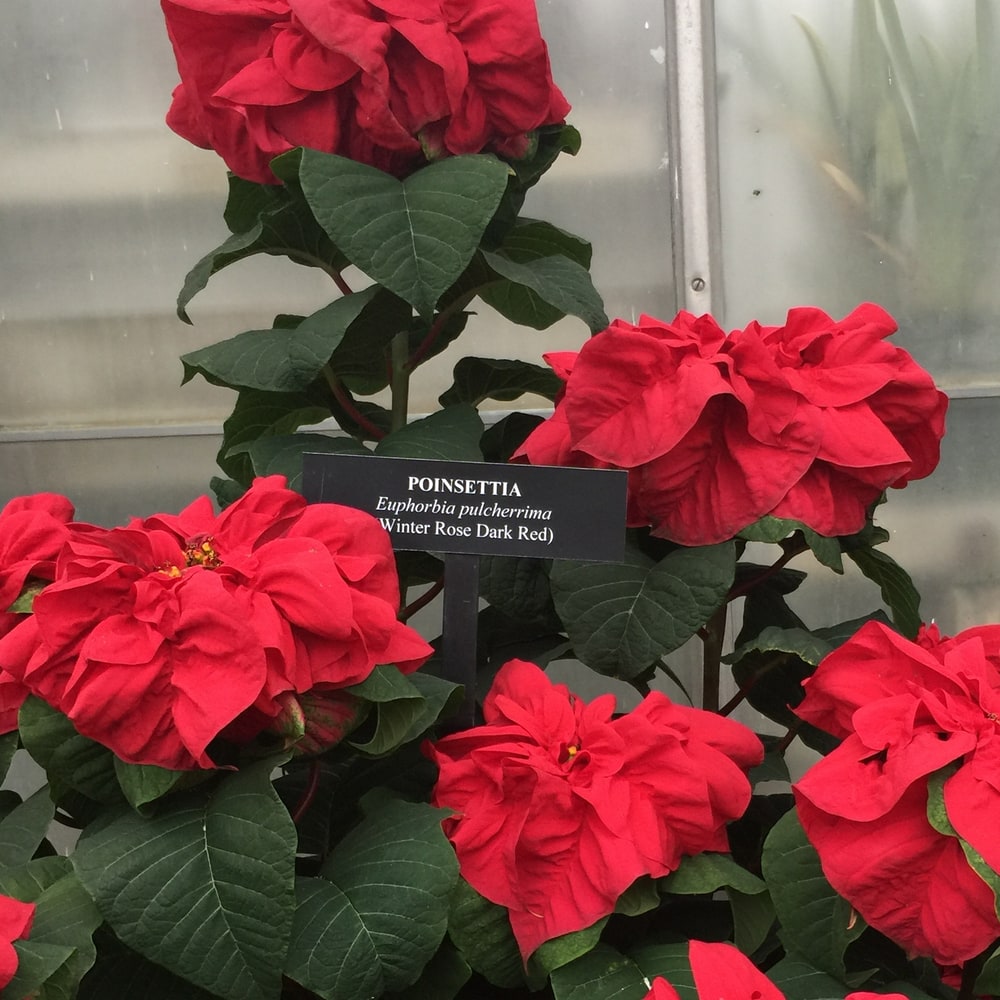
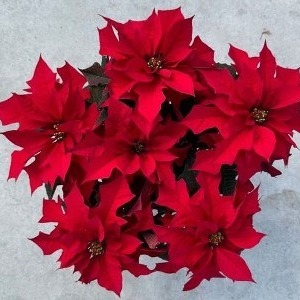
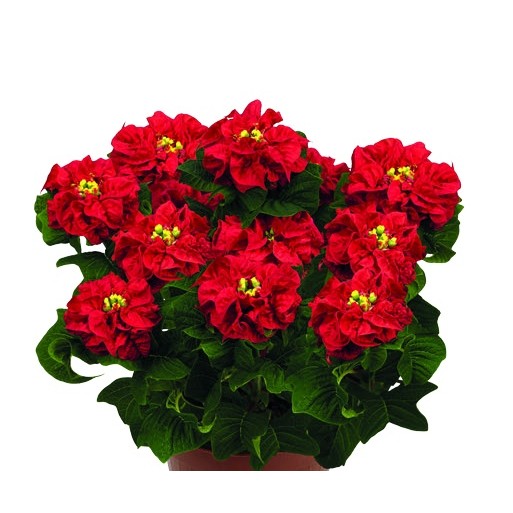
Six poinsettias, side by side
Four change the shape or arrangement of the bracts. Papagena keeps the shape and changes the color.
First, those aren’t actually flowers
Before we get into the unusual varieties, there’s something worth understanding.
The large, colorful parts of a poinsettia aren’t flowers. They’re modified leaves called bracts.
The actual flowers are the tiny yellow-green structures clustered in the center, called cyathia.
Those colorful bracts develop as the plant responds to the longer nights of fall. Their color helps draw attention to the much smaller reproductive structures.
Poinsettias are members of the genus Euphorbia, and their botanical name is Euphorbia pulcherrima.
All the varieties we’re about to look at are cultivated forms of that same species.
Breeders have been selecting changes in the shape, arrangement, and pigmentation of those bracts.
And it turns out there’s quite a lot they can do with them.
The traditional Christmas star
The poinsettia most people recognize has pointed bracts radiating outward from the center.
The overall effect is something like a star.
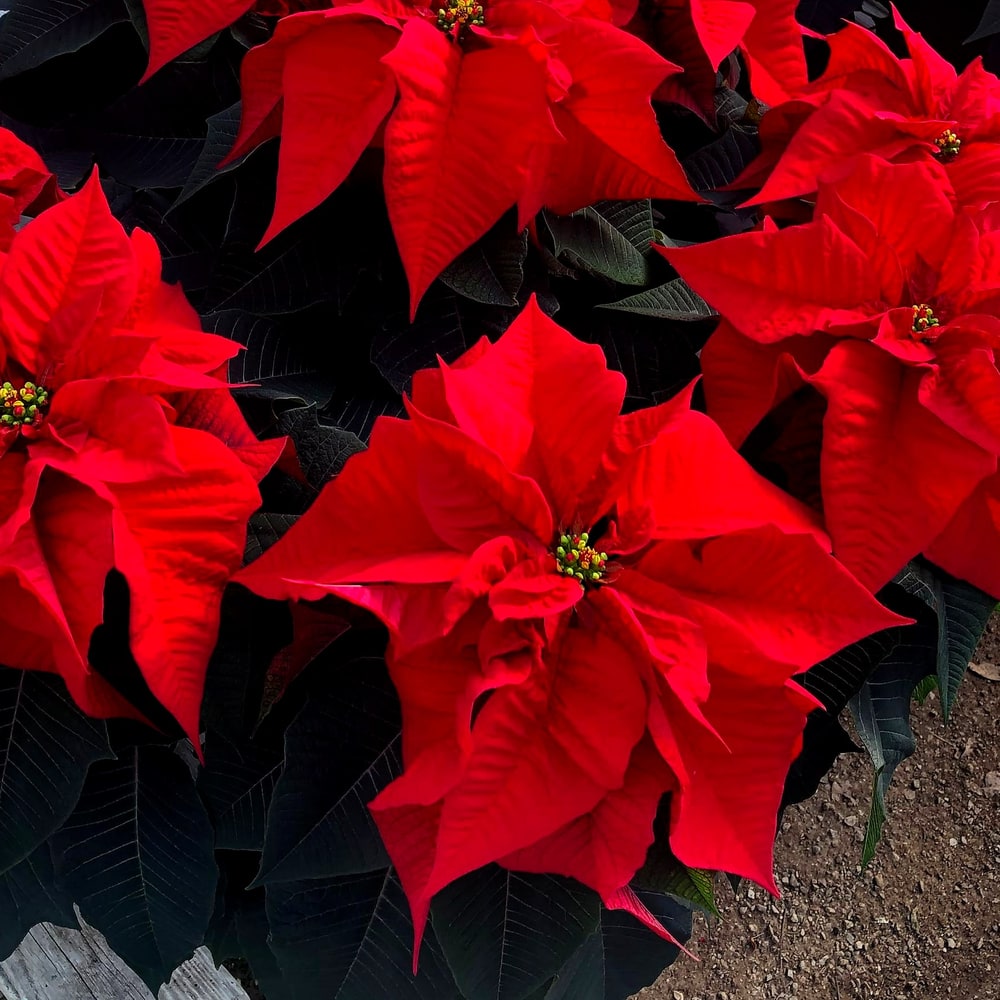
Some varieties have broad bracts, others narrower ones, and some have more pronounced lobes along their edges.
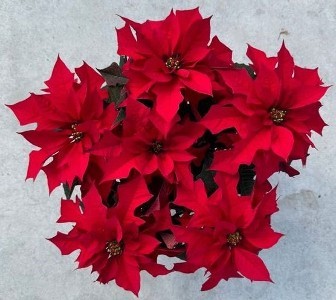
These characteristics vary naturally, but breeders have also selected for more attractive, uniform displays.
The traditional poinsettia has changed enormously over the last century. Modern varieties generally have stronger stems, fuller branching, more predictable flowering, and longer-lasting bracts.
But the basic pointed shape is still what most people associate with Christmas.
It’s also what makes the unusual varieties stand out so dramatically.
A poinsettia with mouse ears
One of the strangest examples is Christmas Mouse, developed by Selecta One.
Instead of the familiar pointed bracts, Christmas Mouse has rounded ones.
They really do look like little mouse ears.
Even the green foliage has a softer, more rounded appearance than what we’re accustomed to seeing on traditional poinsettias.
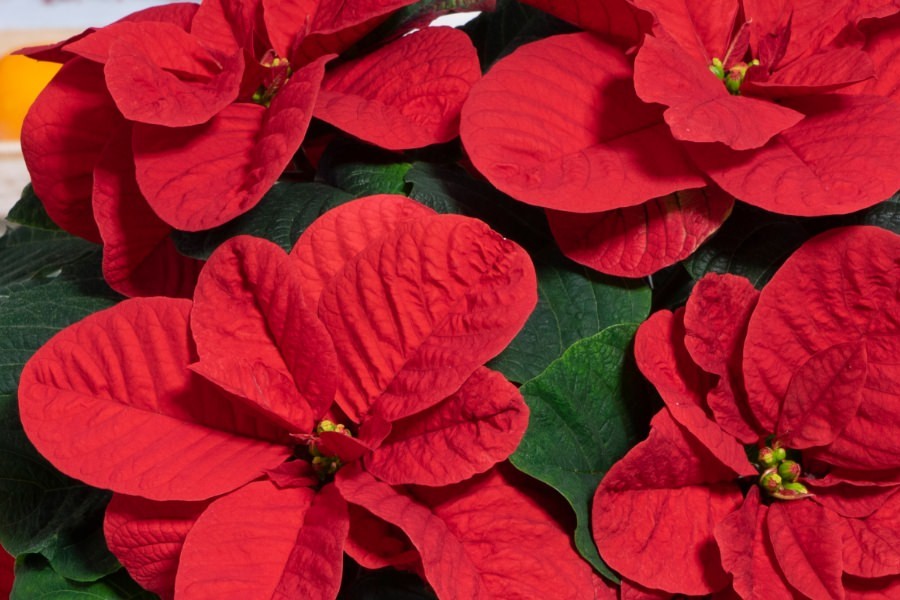
The effect is surprisingly different.
It’s still red. It’s still a poinsettia. But changing the outline of the leaves makes the entire plant look almost like a different species.
Christmas Mouse received a novelty award at IPM Essen in 2019, and it’s easy to see why.
What’s especially interesting is that this isn’t merely an experimental curiosity.
It’s a commercially grown variety.
It has to meet the same practical requirements as other poinsettias: grow consistently, branch properly, develop color at the right time, survive shipping, and remain attractive after customers bring it home.
Breeding an unusual-looking plant is one accomplishment.
Breeding one that works as a commercial crop is another.
The poinsettia that thinks it’s a rose
Then there’s Winter Rose.
Instead of spreading outward in a relatively flat arrangement, its bracts curl inward and downward.
They overlap in a way that makes the plant look like it has little red roses growing at the top.
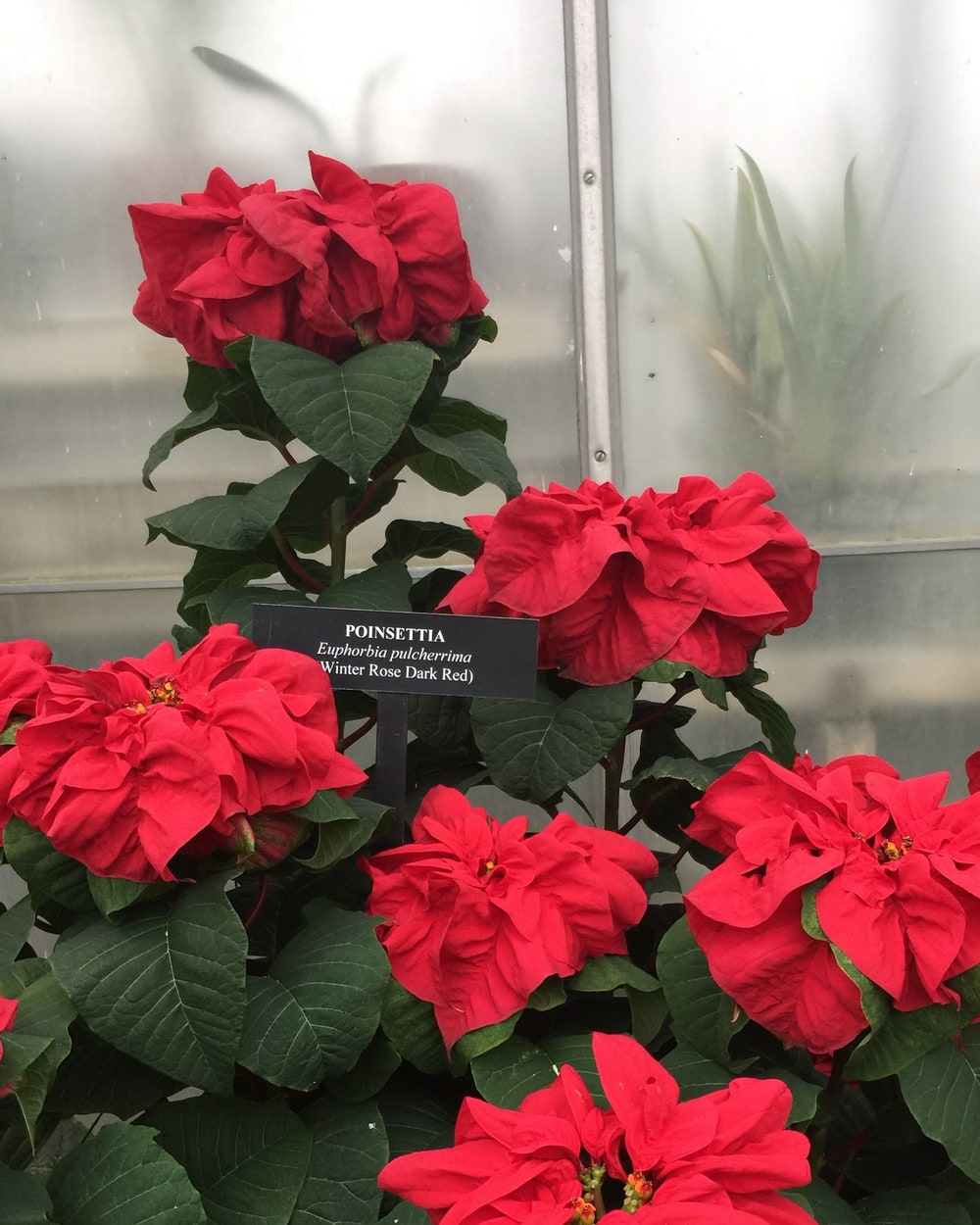
It’s a completely different effect from Christmas Mouse.
Christmas Mouse changes the outline of the leaf. Winter Rose changes how the bracts curl and arrange themselves.
And Winter Rose isn’t particularly new.
It’s been around since the 1990s, demonstrating that breeders have been experimenting with unusual poinsettia forms for decades.
What’s interesting is how these plants can look more like another flowering species than a traditional poinsettia.
Of course, there aren’t any roses growing on them.
It’s still the familiar Euphorbia pulcherrima, with modified leaves surrounding its small flowers.
The ruffled poinsettias
Another direction breeders have explored is the shape of the bract margins.
Carousel Dark Red is a particularly good example.
Its red bracts have distinctly curled, wavy edges rather than the relatively smooth outlines of traditional varieties.
The effect makes the entire colorful display look more textured.
It isn’t quite a rose, and it certainly isn’t a mouse.
It’s simply a poinsettia with a very different arrangement and outline to its bracts.
Some of these unusual shapes have been around for years, but they haven’t necessarily become mainstream.
I suspect part of that is because customers have a very specific picture of what a poinsettia is supposed to look like.
When you change that picture too dramatically, you aren’t simply offering another color.
You’re asking people to reconsider what the plant should look like.
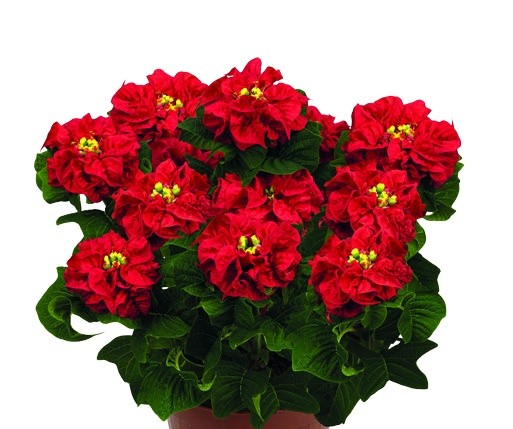
Breeders are still pushing the rose shape
More recently, breeders have continued developing poinsettias that resemble roses.
Roccostar Red, from Lazzeri, is one example.
It produces an unusually sculptural arrangement of bracts that makes the plant look more like a cluster of rose blossoms than the familiar flat Christmas star.
What interests me about these varieties is that the difference isn’t necessarily obvious from across a greenhouse.
They’re still red poinsettias.
But when you get close and look at how the bracts are arranged, they’re remarkably different.
That’s another form of novelty breeding that has very little to do with developing a new color.
And then there’s Papagena
This is one of the varieties that really caught our attention.
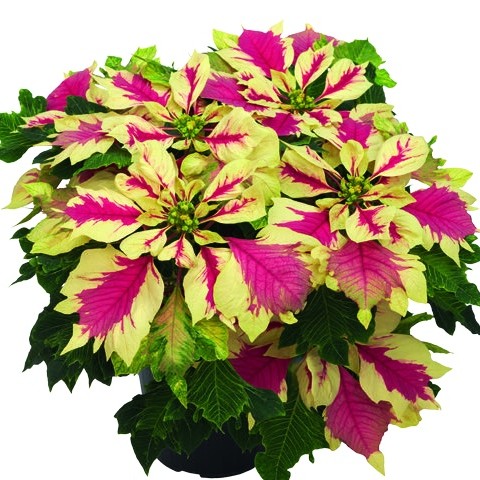
Papagena, from Lazzeri, has an unusual mixture of white and pink across its bracts.
It looks almost as though someone took a paintbrush to the plant.
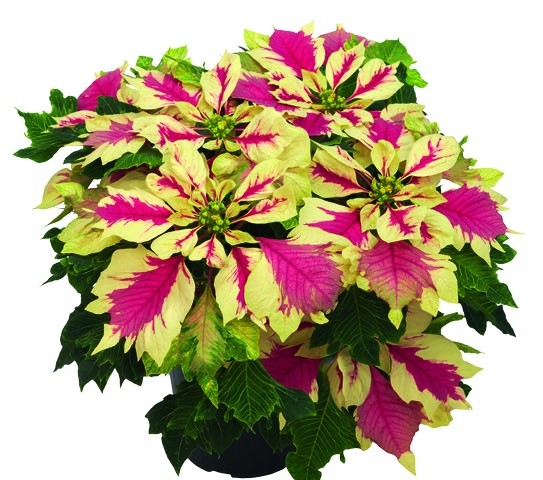
Unlike Christmas Mouse or Winter Rose, the main attraction isn’t a radical change in leaf shape.
It’s the color pattern.
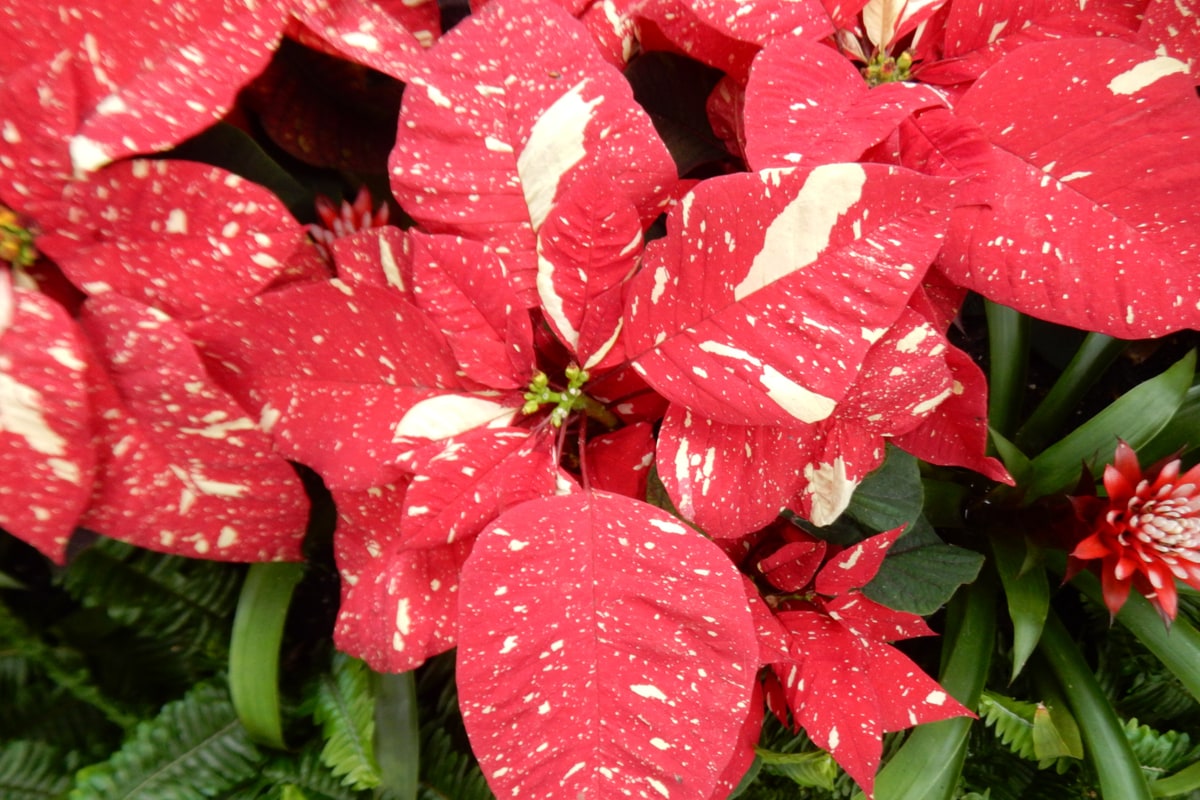
And it’s considerably different from an ordinary pink poinsettia or one with a consistent white-and-pink marble pattern.
When we saw photographs of Papagena, we were immediately interested in growing it.
But then we talked with our sales rep, who sells young plants and had seen Papagena at Lazzeri.
His advice was to stay away from it for our Christmas program.
Under normal growing conditions, it won’t really be fully colored up in time. He told us flat out that it wouldn’t be in color for Christmas, and suggested it might be better suited to Valentine’s Day.
That’s a pretty serious problem for a poinsettia.
Lazzeri’s own catalog notes that its colors come in more intensely when the plants are grown cool, around 59 degrees.
We haven’t grown it ourselves. But when a rep who knows the plant tells you not to grow it for your market, that’s information you have to take seriously.
And the conversation got me thinking about something.
What good is a beautiful poinsettia in February?
Poinsettias are unusual because their commercial value depends so heavily on the calendar.
We spend months growing plants that customers overwhelmingly want to buy during a relatively short period between Thanksgiving and Christmas.
A poinsettia can have exceptional color, unusual leaves, a great growth habit, and everything else we’d like to see in a new variety.
But if it isn’t attractive and ready when customers want to buy it, we have a problem.
That’s a reality breeders deal with constantly.
Poinsettias are short-day plants, or more accurately, long-night plants. Their flowering and bract development are triggered by sufficiently long, uninterrupted nights.
Different varieties respond at different rates.
Some are ready relatively early in the season. Others need additional weeks to develop their full display.
The Christmas deadline
Why timing decides which poinsettias make it
September / October
Long nights begin triggering development.
November
Early varieties become ready for sale.
Thanksgiving through Christmas
The main commercial sales window.
January / February
Much smaller seasonal demand for traditional holiday poinsettias.
Two varieties can be equally beautiful but have very different commercial value if they develop their best color at different times.
Illustrative timing for a typical Christmas crop, not finish dates for any particular variety. Breeders list each variety’s response time: the weeks of long nights it needs to reach a sales-ready stage, often counted to first pollen. Bract color usually comes before that, and a plant can be marketable a few days to two weeks before its tiny flowers shed pollen. Flowering response, color development and finished quality are related, but they aren’t the same thing. Greenhouses also fine-tune the timing with blackout cloth or lights.
Growers select varieties partly on that response time, but flowering response isn’t the only consideration. The timing of attractive bract coloration, plant uniformity, growing temperature, and finished appearance all matter.
When the selling season is as narrow as Christmas, even a modest delay can make a variety difficult to justify.
I wonder how many extraordinary poinsettias have been discovered or developed but never became commercial products because they didn’t finish at the right time.
Maybe there’s a poinsettia with an even stranger leaf shape than Christmas Mouse.
Maybe there’s one with colors nobody has seen before.
Maybe breeders have already found unusual combinations of colors and shapes that look spectacular in January but aren’t dependable for Christmas production.
I don’t know the answer.
But it’s fascinating to think that some of the most interesting poinsettias may never reach a garden center because the calendar works against them.
What could be next?
We’ve already seen poinsettias with rounded bracts, tightly curled bracts, ruffled margins, and increasingly unusual color patterns.
There’s still plenty of room for experimentation.
Could we see more strongly sculpted bracts? More intricate ruffles? Greater variation in the size and arrangement of the bracts?
Could breeders combine the rounded shape of Christmas Mouse with an unusual marble or speckled color pattern?
Or develop a rose-form poinsettia in a color that looks completely different from traditional Christmas red?
Some of those combinations may already exist in experimental breeding programs. Others might prove difficult or impractical to develop.
Changing one characteristic doesn’t guarantee that all the other desirable traits will come along with it.
And that might be the most important part of the story.
A breeder isn’t simply trying to create something unusual.
They’re trying to create something unusual that can still be grown, shipped, sold, and enjoyed.
For poinsettias, that also means getting the timing right.
The plant doesn’t know what Christmas is
I think there’s something rather funny about the amount of effort we’ve put into breeding poinsettias.
We’ve spent generations improving their stems, branching, colors, durability, and shape.
We’ve managed to make a plant that naturally grows into a large tropical shrub behave like a compact holiday houseplant.
And now we’re making them look like mice and roses.
But despite all of that progress, one of the biggest constraints hasn’t changed.
They still need to look their best at Christmas.
The natural timing of poinsettias helped make them famous in the first place. Their transformation from green foliage to colorful bracts arrived just when people were decorating their homes for the holiday.
That annual display was remarkable enough that people kept buying poinsettias even when the plants themselves were far less dependable than what we grow today.
Now that same Christmas connection determines which new varieties succeed commercially.
Maybe someday we’ll be growing a Papagena-type poinsettia that develops its remarkable coloring reliably before Thanksgiving.
Or maybe somebody will figure out how to make poinsettias desirable well beyond Christmas.
Either way, I hope breeders keep experimenting.
Because after growing these plants for so many years, I still find it exciting when somebody comes up with one that barely looks like a poinsettia at all.
And there’s something worth remembering about all this.
The plant doesn’t know what Christmas is. We do.
Hoosier Tip
When you shop for one of these unusual poinsettias, look past the bracts to the tiny flowers in the center. Pick a plant whose yellow-green buds are still tight, with little or no pollen showing, because once they shed pollen the bracts don’t hold as long. On curled types like Winter Rose, gently tip a bract back to check.
More on plant spotlights, every Friday
Three growing guides like this one and a short note from the greenhouse, free, once a week. Written for Indiana gardens.
Reference: Taylor, Lopez, Currey and Janick, The Poinsettia: History and Transformation, Chronica Horticulturae (2011); NC State Extension Plant Toolbox, Euphorbia pulcherrima; Texas A&M AgriLife, Texas Poinsettia Producers Guide: Cultural Characteristics; Camberato, Krug and Lopez (Purdue), Energy Efficient Poinsettia Production; Greenhouse Grower, Eight Award-Winning Varieties From IPM Essen (2019); NC State Poinsettia Trials, Winter Rose Early Red; US Plant Patent PP17,657, Carousel Dark Red; Illinois Extension, Good Growing Ep. 194; Lazzeri, Poinsettia Collection 2026; Dümmen Orange, new poinsettia varieties (Dec. 2024); Schlegel Greenhouse production notes.