 Behind the Scenes
Why Your Mums Might Be Late This Year: Understanding Heat Delay

Vice President & Owner, Schlegel Greenhouse · September 3, 2026
We spend months planning when our mums will flower — and a hot week in August can quietly push that whole schedule back.
Different varieties are selected to bloom at different times. We have early mums, mid-season mums and late mums, which allows us to send fresh plants to garden centers throughout the fall instead of having everything flower at once.
But plants don’t always follow our schedule perfectly.
One of the biggest reasons is heat delay.
Mums Need More Than Shorter Days
We’ve talked before about chrysanthemums being short-day plants. As summer progresses and nights become longer, that change in day length tells a mum that fall is approaching and it’s time to begin flowering.
That’s only part of the equation. Temperature matters too.
A mum can be receiving exactly the right amount of darkness to initiate flowers, but if temperatures — particularly nighttime temperatures — stay too high, flower development can slow down.
That’s heat delay.
UMass Extension notes that warm nights above roughly 73°F can delay flowering, while Greenhouse Grower reports that sustained temperatures above roughly 85°F can push mum flowering back by one to three weeks under some conditions. The exact response depends heavily on the variety.
What Is Heat Delay?
Days get shorter
↓
Mum receives its flowering signal
↓
|
Normal temperatures Bud development continues |
Excessive heat Bud development slows |
When the Heat Happens Matters
This is where it gets more technical. A mum isn’t equally sensitive to heat throughout the entire flowering process.
The most critical period is generally the first couple of weeks after short days begin, when the plant is initiating its flower buds.
Research summarized by UMass found that high night temperatures during those first two weeks can have a much greater effect than the same temperatures later in flower development. After about three weeks of short days, high temperatures may still slow flowering, but the effects aren’t necessarily as severe.
That’s why a heat wave in July or August can matter to a crop you’re planning to sell weeks later. By the time you notice that a mum is late, the weather that caused it may have happened a month ago.
Not Every Mum Reacts the Same Way
This is another reason variety selection matters so much to growers. Some mum varieties are considerably more sensitive to heat delay than others, and breeders specifically evaluate this.
Look through a professional mum catalog and you’ll find varieties described for their heat tolerance or even their lack of heat delay. Ball, for example, describes Mumma Mia Red as having great heat tolerance with “no heat delay,” while other cultivars can be considerably more sensitive.
That’s valuable to us. If we’re trying to grow an early mum that needs to flower during the hottest part of the season, we don’t necessarily want genetics that are extremely sensitive to high temperatures.
Heat Can Do More Than Make a Mum Late
Really high temperatures can affect more than the calendar. Growers can see:
- ✓ Uneven flowering
- ✓ Deformed buds
- ✓ Poor branching
- ✓ Reduced growth
- ✓ Changes in flower color
- ✓ Crown buds
Ball notes that once temperatures get above roughly 86°F, growth and development in mums can begin slowing considerably.
So despite mums being the plant everyone associates with September and October, a lot of the work required to make a beautiful fall mum happens during the hottest part of summer.
Can Growers Control It?
To an extent. Commercial growers can manipulate day length with black cloth, essentially creating an artificial night to tell the plant it’s time to flower. That’s how growers can produce mums for dates that wouldn’t occur naturally.
But there’s an interesting problem. Put black cloth over a mum crop on a hot evening and you can trap heat underneath it — which can actually contribute to the heat delay you’re trying to avoid.
Ball recommends keeping black cloth above the crop for airflow and managing the timing of shading to prevent excessive heat buildup.
It’s a good example of how growing mums is a lot more technical than it looks.
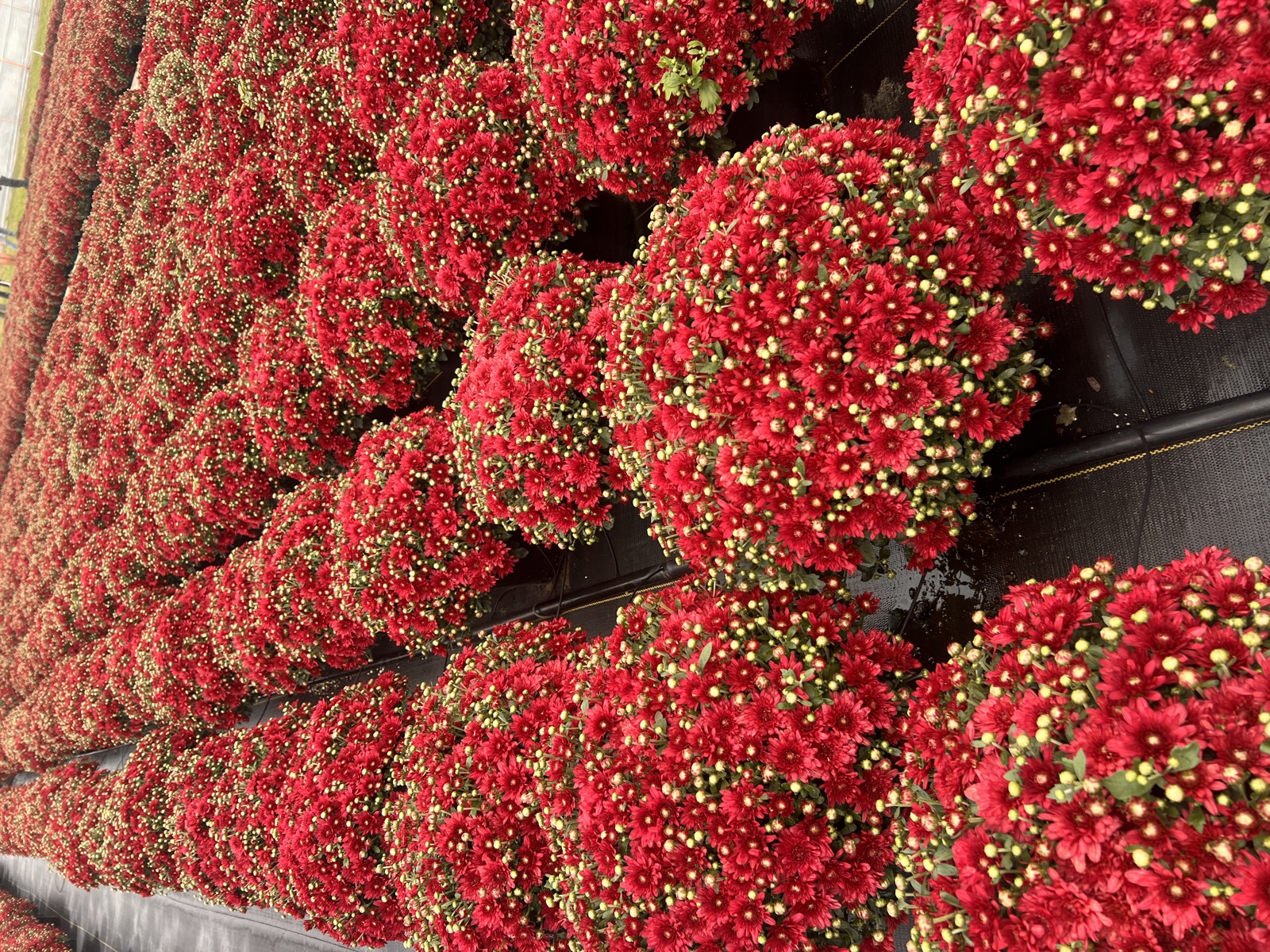
You see a perfectly round plant covered with hundreds of flowers. We see a crop where variety, planting date, day length, nighttime temperature, irrigation and nutrition all had to line up at the right time.
Hoosier Tip
If a mum you bought in tight bud seems to be taking its time opening, give it a few cooler nights before you worry. Keep it watered, keep it in good light, and let the temperature do what the calendar couldn’t. In most cases the flowers are coming — they’re just running a little behind.
More on behind the scenes, every Friday
Three growing guides like this one and a short note from the greenhouse, free, once a week. Written for Indiana gardens.
Reference: UMass Extension, Garden Mum Production · Greenhouse Grower · Ball Seed garden mum culture notes · Schlegel Greenhouse production notes