 Plant Spotlights
Night Sky Petunias: How a Mutation Became One of the Most Unique Plants in the Industry

Owner, Schlegel Greenhouse · April 9, 2026
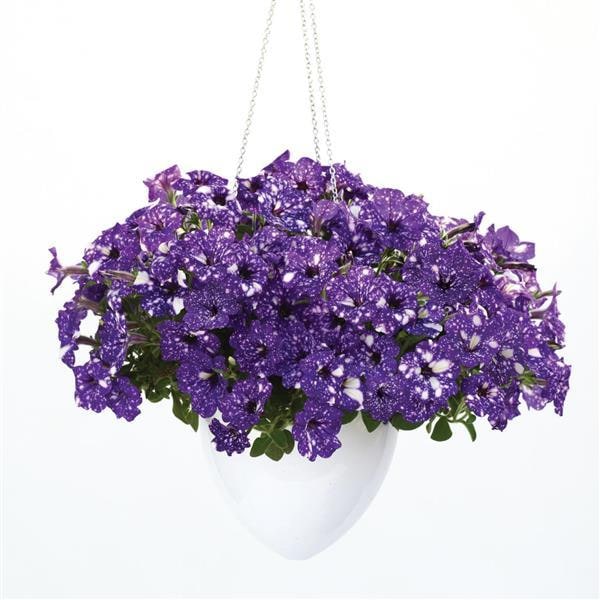
Every once in a while, a plant comes along that stops people in their tracks. Night Sky petunia is one of those plants. Deep purple blooms splashed with white speckles — like a galaxy. No two flowers exactly the same. It doesn't just look different. It is different.
Where Night Sky Came From
Night Sky wasn't designed on paper. It started as a genetic mutation — a natural change in how pigment was distributed in the petals. Instead of solid color, the plant produced irregular white speckling across a dark background.
Breeders saw it and did what great breeders do: isolate the trait, stabilize it, and turn it into a consistent, sellable plant. That's what companies like Selecta One spent years refining before it ever hit retail. And even now, part of what makes Night Sky special is that it's not perfectly predictable.
Why the Pattern Changes (and Why That's Actually Cool)
One of the most interesting things about Night Sky: the pattern responds to temperature.
- ✓ Cooler nights → more white speckling
- ✓ Warmer nights → deeper purple, fewer “stars”
So the plant literally changes its appearance based on its environment. That's not a flaw — that's part of the appeal. It's a plant that reacts to where it lives.
How Vegetative Petunias Changed the Game
Night Sky isn't just unique because of color. It's part of a broader category: vegetative petunias. These are not grown from seed — they're propagated from cuttings. That matters more than most people realize.
Because they're cloned, vegetative petunias are genetically identical, selected for vigor and performance, and bred specifically for uniform growth and flowering. According to GrowerTalks Magazine, Night Sky is genetically stable in terms of branching, vigor, and timing, even if the color pattern shifts with environment.
That's the key distinction: seed petunias are bred for ease of production. Vegetative petunias are bred for performance in the landscape and containers.
Why They Often Outperform “Wave” Petunias
Wave petunias had their moment — and they're still good plants. But vegetative types like Night Sky and Headliner tend to:
- ✓ Branch more aggressively
- ✓ Fill containers faster
- ✓ Flower more consistently over time
- ✓ Recover better from stress
They're simply more refined from a breeding standpoint. They've been selected not just to grow — but to look good all season.
Why Headliner Petunias Are So Good in Containers
Night Sky is often paired with or compared to the Headliner series — and for good reason. Headliner petunias are designed with containers in mind. They start mounded, then transition to a controlled trailing habit. That means you get fullness early, spill later, and you don't end up with a plant that collapses or thins out. Night Sky itself fits into this same performance class — early flowering, well-branched, and adaptable to container production.
The Practical Takeaway
Night Sky petunias aren't just a novelty. They represent what modern plant breeding is aiming for: unique visual appeal, strong reliable performance, and adaptability to real-world conditions. And maybe most importantly — they're plants people actually enjoy watching over time. Because they change. They respond. They don't stay static.
If You're Choosing Between Petunias
- ✓ Seed petunias (like Wave) → dependable, cost-effective, broad use.
- ✓ Vegetative petunias (like Night Sky, Headliner) → higher performance, better containers, more visual impact.
Both have a place. But if you want something that fills out faster, holds up longer, and actually stands out — you're usually better off going vegetative.
Hoosier Tip
Night Sky works because it breaks the rules. It's not uniform. It's not predictable. And in a world full of identical plants, that's exactly why people love it.
More on plant spotlights, every Friday
Three growing guides like this one and a short note from the greenhouse, free, once a week. Written for Indiana gardens.
Reference: GrowerTalks Magazine · Selecta One breeding notes