 Plant Care
Why Fertilizer Can Hurt Plants (And What “Salts” Actually Means)

Sales Director & Design Expert · May 20, 2026
One of the biggest misconceptions in gardening is this: if fertilizer helps plants grow, more fertilizer must help them grow even more.
Plants don’t really work that way. And understanding why explains a lot of the problems that show up in annuals, hanging baskets, and containers during Indiana summers.
What Fertilizer Actually Is
When people hear the word “salts” in fertilizer, it sounds scary. But in horticulture, “salts” does not mean table salt. It means:
- ✓ Dissolved minerals
- ✓ Nutrients carried in water
- ✓ Elements roots can absorb
Things like nitrogen, potassium, calcium, and magnesium.
According to Purdue Extension and Penn State Extension, water-soluble fertilizers dissolve into ions in water so that roots can absorb them. Plants do not absorb fertilizer granules directly — they absorb nutrient-rich water.
So Why Can Too Much Fertilizer Hurt Plants?
Because fertilizer changes how water moves around roots. This is the important part:
Extremely concentrated fertilizer can make it harder for roots to absorb water properly.
In severe cases:
- ✓ Roots become stressed
- ✓ Foliage burns
- ✓ Leaf edges crisp
- ✓ Plants wilt even though fertilizer was added
That’s why people sometimes fertilize a struggling plant… and it looks even worse afterward.
This Happens More in Containers
Especially:
- ✓ Hanging baskets
- ✓ Patio pots
- ✓ Small containers
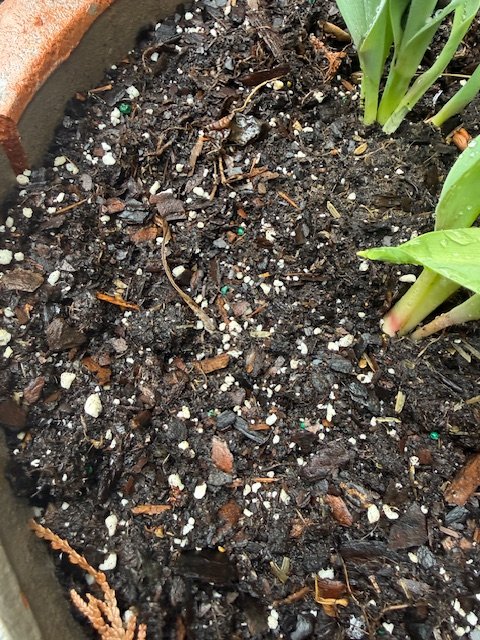
Why? Because containers heat up quickly, water evaporates faster, and fertilizer salts become concentrated faster. Indiana summer heat amplifies all of it.
The Most Common Mistake
People often see a stressed plant, assume it needs fertilizer, and feed it heavily. But sometimes the plant was actually:
- ✓ Too dry
- ✓ Too hot
- ✓ Root-stressed
And adding fertilizer just put more pressure on already-struggling roots.
One of the Best Things to Do
Water deeply until water runs out of the bottom of the pot.
Why? Because it:
- ✓ Flushes excess salts
- ✓ Refreshes the root zone
- ✓ Reduces buildup over time
If containers are only lightly watered repeatedly, salts can accumulate. This is especially common in hanging baskets.
How to Avoid Fertilizer Stress
Feed consistently, not aggressively. Annuals respond better to steady nutrition than giant fertilizer spikes.
Don’t fertilize wilted plants. Water first. Let the plant recover. Then feed later.
Understand heat changes everything. The hotter the root zone, the more sensitive plants become to fertilizer stress.
A Simple Way to Think About It
Fertilizer is not plant energy. It’s dissolved minerals carried in water. Just like electrolytes for people — the right amount helps, too much causes problems.
The Real Takeaway
Most annuals don’t decline because they weren’t fertilized enough. They decline because:
- ✓ Roots became stressed
- ✓ Salts accumulated
- ✓ Watering became inconsistent
- ✓ Conditions became too extreme
Good growers don’t just think about fertilizer. They think about the entire root environment.
Hoosier Tip
Once every 3–4 weeks, give containers and hanging baskets a deep, plain-water flush — enough that water runs cleanly out the bottom for 10–15 seconds. It’s the simplest way to reset salt buildup before it stresses the roots.
More on plant care, every Friday
Three growing guides like this one and a short note from the greenhouse, free, once a week. Written for Indiana gardens.
Reference: Purdue University Extension, Penn State Extension, Ohio State University Extension — Indiana gardening resources