
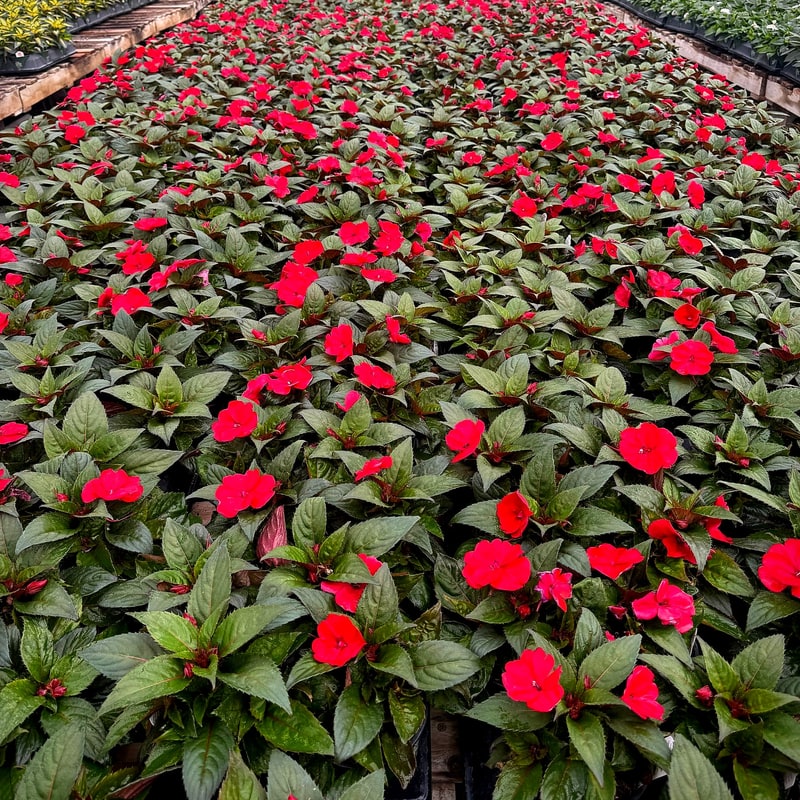
 Greenhouse
What Are PGRs, and Why Do Greenhouses Use Them?

Owner, Schlegel Greenhouse · October 9, 2026
A landscaper asked me whether we use PGRs, and when I said yes, he said he did not want them. I understood where he was coming from, but I think he had a narrower definition of the word in his head than the one growers use, and that gap is worth closing.
It Stands for Regulator, Not Retardant
PGR means plant growth regulator. A lot of people hear it as plant growth retardant, a chemical that makes a plant stay small, and that is one thing some PGRs do. It is not what the category means.
Plants already regulate their own growth with naturally occurring hormones. The main groups are auxins, gibberellins, cytokinins, ethylene and abscisic acid. They decide whether a stem stretches or stays short, whether a cutting makes roots, whether a side bud breaks, when a flower opens. Commercial PGRs are compounds that interact with those same processes. Some are the plant’s own hormones made in a factory. Others block one of them. Which direction a product pushes depends entirely on which product it is, and that is the whole point of this article.
Six Different Jobs
Controlling stretch. This is the one everybody knows about. Products like paclobutrazol, uniconazole, daminozide and chlormequat work by interrupting the plant’s production of gibberellin, the hormone that drives cell expansion in the stem. Less gibberellin means shorter spaces between leaves and a stockier, thicker-stemmed plant. The reason we want that has nothing to do with making a plant small for its own sake. A petunia in a 4.5-inch pot with three long floppy stems is not a better plant because it is physically bigger. It will tangle on the cart, snap in shipping, flop on the garden center bench and arrive at your house looking like it lost a fight. A proportional, well-branched plant survives all of that and establishes faster once it is in the ground.
Encouraging branching. A plant’s growing tip produces auxin, which suppresses the buds below it. Growers call that apical dominance, and it is why pinching the tip of a plant makes it bushier. Some PGRs do the same thing chemically. Benzyladenine, a synthetic cytokinin, and dikegulac-sodium both reduce apical dominance and push side buds to break. Ball Seed’s technical guidance describes it as a chemical pinch. More branches means more growing points and, on most flowering annuals, a fuller plant with more flowers.
Encouraging rooting. This is the example that usually changes people’s minds. The rooting powder sold at every garden center is indole-3-butyric acid, an auxin, sometimes blended with a related compound called NAA. Kansas State’s extension guide for nurseries lists them plainly as plant growth regulators that increase the percentage of cuttings that root and the number of roots each one makes. If you have ever dipped a cutting in rooting hormone, you have applied a PGR.
Making plants grow more. This is the surprising one. Gibberellic acid products do the opposite of the retardants. Growers use them to stretch a crop that came in too compact, to lengthen stems on cut flowers, and to correct a plant that received too heavy a dose of a retardant. A greenhouse that overshoots on height control can apply gibberellin and watch the plant resume normal growth. The same toolbox that slows a plant down can speed it back up.
Managing flowering. Ethephon breaks down into ethylene inside the plant, and ethylene can abort flowers and flower buds. Growers use it on stock plants, the mother plants we take cuttings from, to keep them vegetative and productive instead of letting them bloom. Gibberellin and cytokinin products can promote flowering in some crops, and on poinsettias the timing of a retardant has to be managed carefully because a late application shrinks the colored bracts.
Other responses. Depending on the crop and the chemistry, PGRs are also used to shape plant architecture, to thicken stems, to delay flowering so a crop hits its ship date, and to improve the canopy on plants that would otherwise be sparse.
Will It Stay Small After I Take It Home?
This is the real question behind the landscaper’s concern, and the answer is that it depends on what was used and how. The response of a plant depends on the chemistry, the rate, the crop, whether it was sprayed or drenched, when in the crop cycle it was applied and how warm and bright the greenhouse was. Purdue’s PGR reference lists most spray applications as remaining active for one to two weeks and drenches for three to four, and the goal of a well-run program is a plant that is proportional on the day it ships and then grows normally in your garden.
Overapplication is possible. A plant that was drenched too hard will sit there without growing for weeks, and professional growers go to real lengths to avoid it, because a stalled crop costs us money and a reputation. We trial rates on a few trays before treating a house, apply lower rates more often rather than one heavy dose, and back off when the weather turns cloudy and cool, because a plant that is not growing fast does not need to be slowed down. Proper PGR use is not meant to freeze a plant at retail size forever.
PGRs Are Not a Substitute for Growing Well
I want to be clear that a chemical is not the first tool we reach for. Most of the height and shape of a plant comes from how it is grown. Keeping nights warmer than days, or dropping the temperature for a couple of hours at dawn, makes plants shorter without touching them. So does more light, which is why spacing plants out and keeping the plastic clean matters. Letting a crop dry slightly between waterings toughens it. Fertilizer, pinching and the size of the container all shape the finished plant. A grower who gets those things right needs very little in the way of PGRs, and a grower who gets them wrong will not be rescued by them.
So if someone tells me they do not want a plant that was treated with a PGR, the first thing I would ask is: which kind? Because PGR describes a toolbox, not a single treatment. The rooting hormone that started the cutting and the growth regulator that kept it from flopping in the box are both in it. What matters is what the grower used, why they used it and whether they used it well.
Hoosier Tip
If a plant you bought seems stuck at the same size for more than three or four weeks after planting, with good light and water, give it a dose of fertilizer and some patience. Properly used, a growth regulator wears off. A plant that was simply rootbound and dry usually just needs to settle in, and the two look alike for the first couple of weeks.
Reference: Purdue Extension, Plant Growth Regulators for Greenhouse Production: Pocket Reference (HO-248-B-W); Oregon State Extension, How Hormones and Growth Regulators Affect Your Plants; Ball Seed Tech Training, GA Biosynthesis Inhibitors, Benzyladenine, Ethephon and Gibberellin-Based Products; Kansas State Research and Extension, Use of Root-Promoting Products (MF3105); UMass Extension, Controlling Plant Height Without Chemicals; Greenhouse Grower, Digital Deep Dive on Plant Growth Regulators; Schlegel Greenhouse production notes.